
Installation
Before installing the extension, please make sure to Backup your web directory and store database
You will require to install MageDelight Base Extension first. If it is not installed then please download it from https://www.magedelight.com/pub/extensions/magedelight-base.zip and unzip the package file into the root folder of your Magento 2 installation.
Root Directory is - "app/code/magedelight/#YourExtensionName#"
- Unzip the extension package file into the root folder of your Magento 2 installation.
- Connect to SSH console of your server:
- Navigate to the root folder of your Magento 2 setup
Run command as per below sequence,
php bin/magento setup:upgrade
php bin/magento setup:di:compile
php bin/magento setup:static-content:deploy
php bin/magento cache:clean
- log out from the backend and log in again
If you are using Magento 2.3 or later then you do not need to activate license. Extension will be activated with silent activation mechanism and does not require activation keys to be entered manually.
Backend Configuration (Admin side)
Search Ultimate
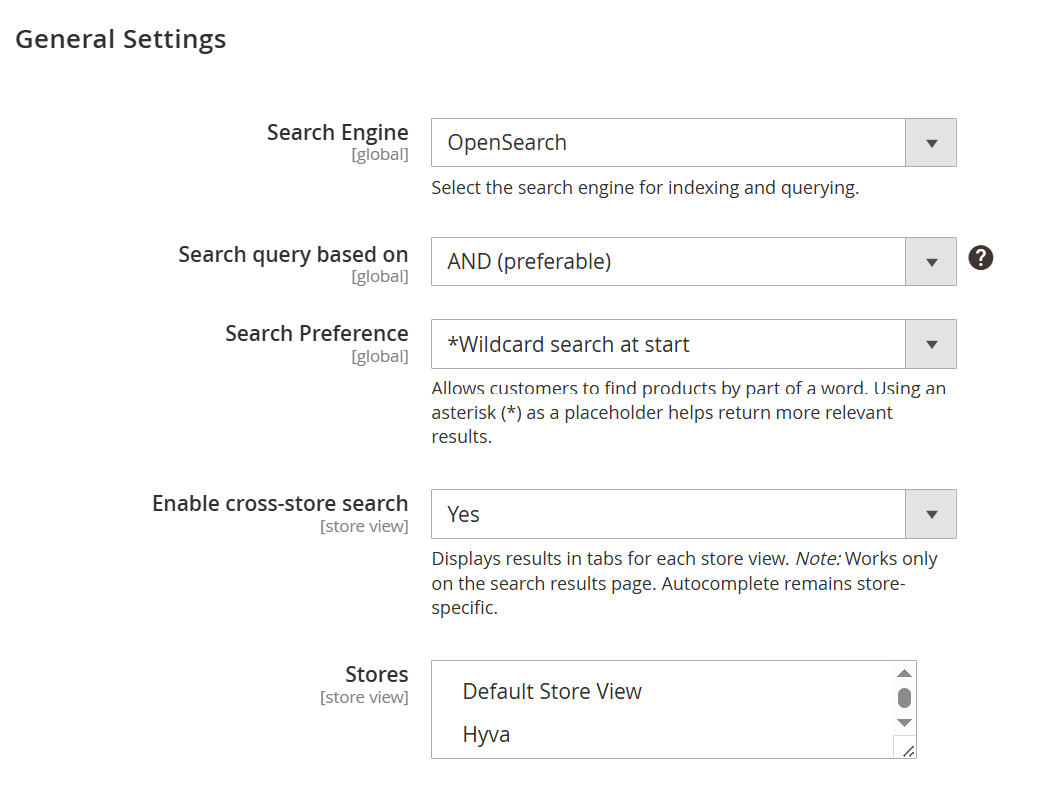
- This section allows administrators to configure the search behavior and optimize how products are indexed and displayed in search results across the store.
| Field | Description |
|---|---|
| Search Engine | Selects the backend search engine used for indexing and querying catalog data. Available options include MySQL, Elasticsearch (deprecated), and OpenSearch. OpenSearch is recommended for better performance and scalability. |
| Search Query Based On | Defines how multiple search terms are combined. AND (preferable) returns results containing all keywords, improving accuracy. OR returns results containing any of the keywords, increasing result breadth. |
| Search Preference | Controls how wildcard searches are applied to improve partial matching of search terms. Options include: • Wildcard Search – Matches terms containing the keyword anywhere. • Wildcard search at start – Matches terms ending with the keyword. • Wildcard search at end* – Matches terms starting with the keyword. • No – Disables wildcard search. |
| Enable Cross-Store Search | Enables displaying search results across multiple store views. When enabled, results appear in separate tabs per store on the search results page. Autocomplete remains store-specific. |
| Stores | Allows selection of store views where cross-store search is applicable. Only relevant when cross-store search is enabled. |
| Field | Description |
|---|---|
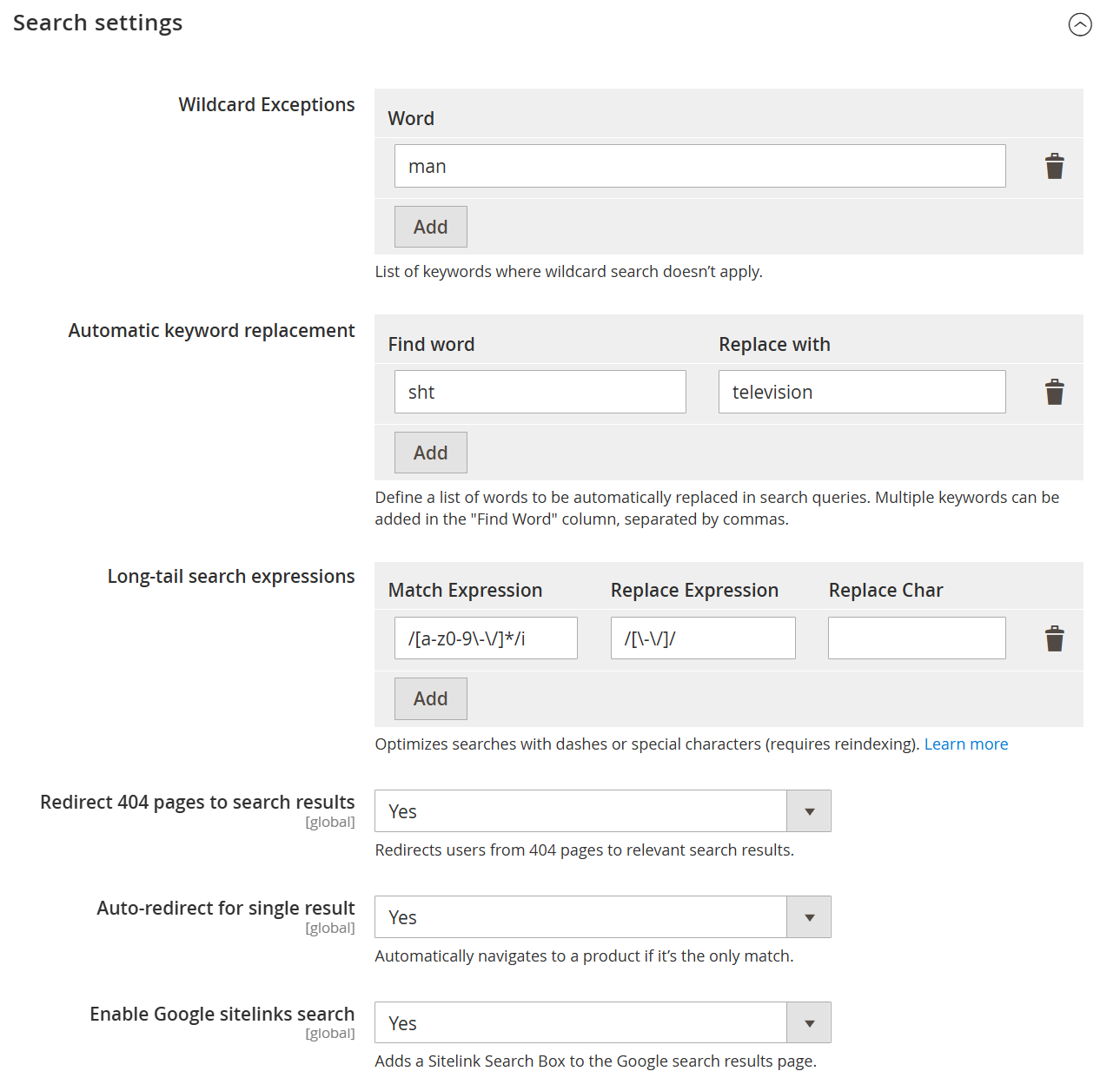
| Wildcard Exceptions | Defines keywords for which wildcard search should not be applied. This helps maintain precise search results for specific terms. |
| Word | Specifies the keyword to exclude from wildcard-based search behavior. |
| Add | Adds the entered keyword to the wildcard exception list. |
| Automatic Keyword Replacement | Allows automatic replacement of search terms to improve result accuracy and handle common misspellings or synonyms. |
| Find Word | Defines the keyword(s) that should be detected in the search query. Multiple words can be added, separated by commas. |
| Replace With | Specifies the term that will replace the matched keyword in the search query. |
| Add (Keyword Replacement) | Adds the defined find-and-replace rule to the list. |
| Long-tail Search Expressions | Configures advanced search patterns using expressions to handle special characters, formatting, or complex queries. |
| Match Expression | Defines the pattern (e.g., regex) to identify specific search query formats. |
| Replace Expression | Specifies the expression used to transform the matched query into a searchable format. |
| Replace Char | Defines a character used during replacement, if applicable. |
| Add (Expression) | Adds the configured long-tail search rule. |
| Redirect 404 Pages to Search Results | Redirects users from non-existent (404) pages to relevant search results, improving user experience. |
| Auto-redirect for Single Result | Automatically redirects users to the product page if the search query returns only one result. |
| Enable Google Sitelinks Search | Enables a sitelinks search box in Google search results for the store, improving SEO and navigation. |
| Field | Description |
|---|---|
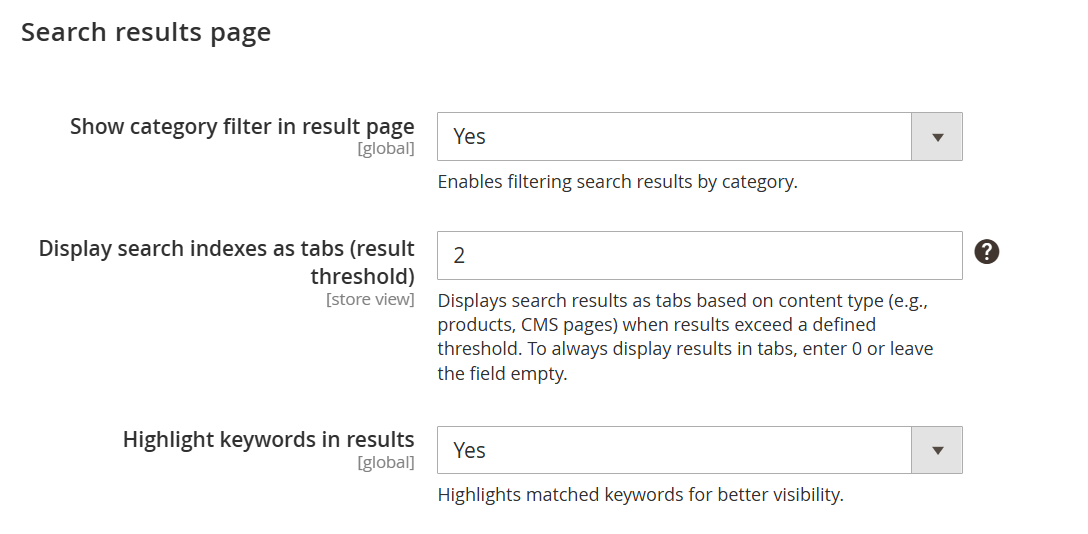
| Show Category Filter in Result Page | Enables category-based filtering on the search results page, allowing users to refine results by category. |
| Display Search Indexes as Tabs (Result Threshold) | Displays search results in tabbed format based on content types (e.g., Products, CMS Pages) when the number of results exceeds the specified threshold. Enter 0 or leave empty to always display tabs. |
| Highlight Keywords in Results | Highlights matched search keywords within the results to improve visibility and user experience. |
| Field | Description |
|---|---|
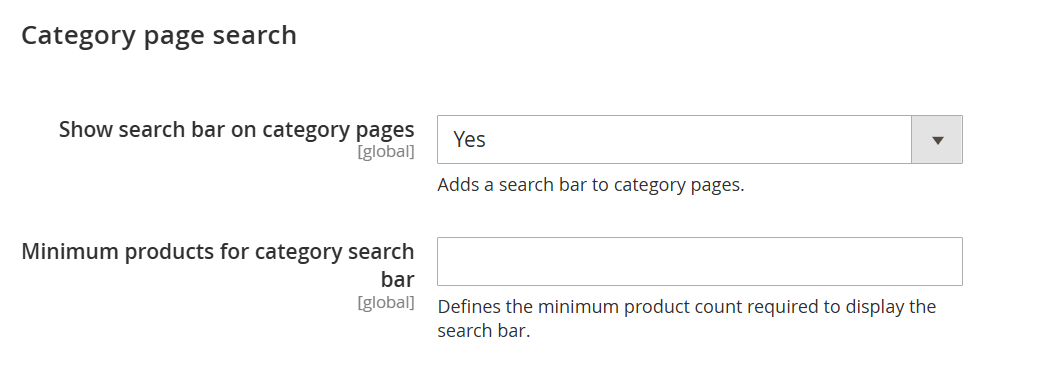
| Show Search Bar on Category Pages | Enables a search bar on category pages, allowing users to search for products within the selected category. |
| Minimum Products for Category Search Bar | Defines the minimum number of products required in a category for the search bar to be displayed. If the product count is below this value, the search bar will not appear. |
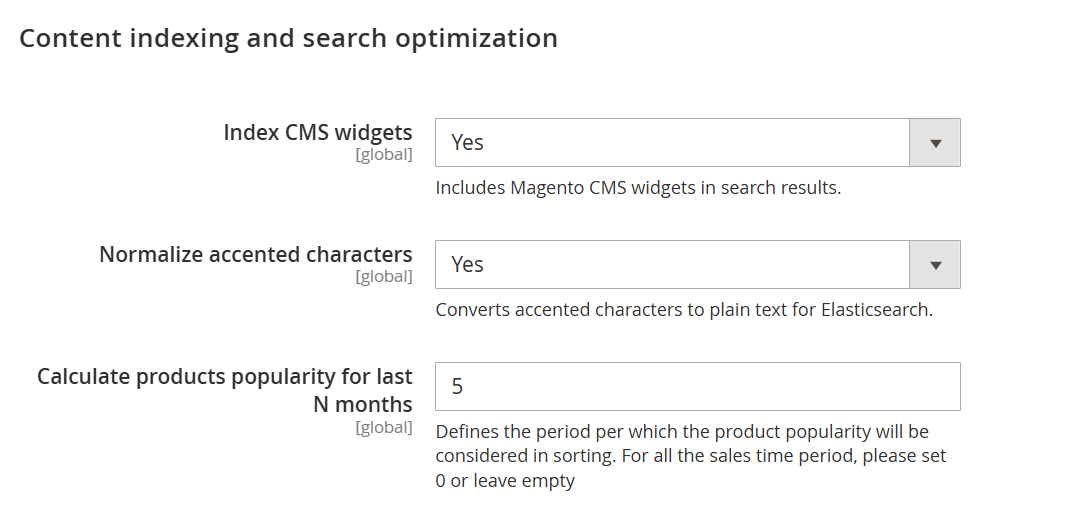
| Field | Description |
|---|---|
| Index CMS Widgets | Includes Magento CMS widgets in search indexing, allowing their content to appear in search results. |
| Normalize Accented Characters | Converts accented or special characters into standard text to improve search matching and consistency. |
| Calculate Products Popularity for Last N Months | Defines the time period (in months) used to calculate product popularity for sorting purposes. Set 0 or leave empty to consider all-time data. |
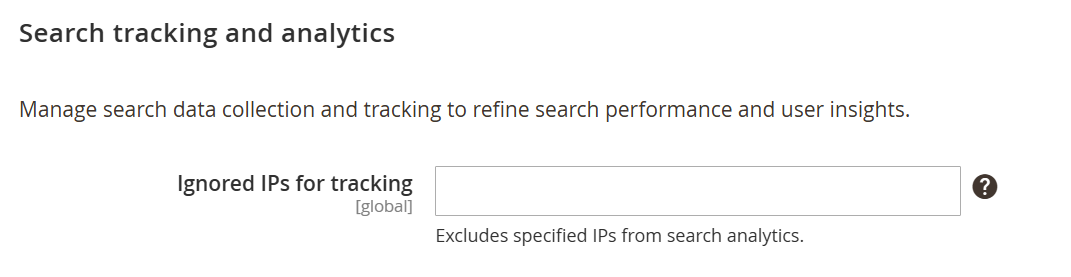
| Field | Description |
|---|---|
| Ignored IPs for Tracking | Specifies IP addresses that should be excluded from search analytics and tracking. This is useful for filtering out internal or test traffic to ensure accurate search data. |
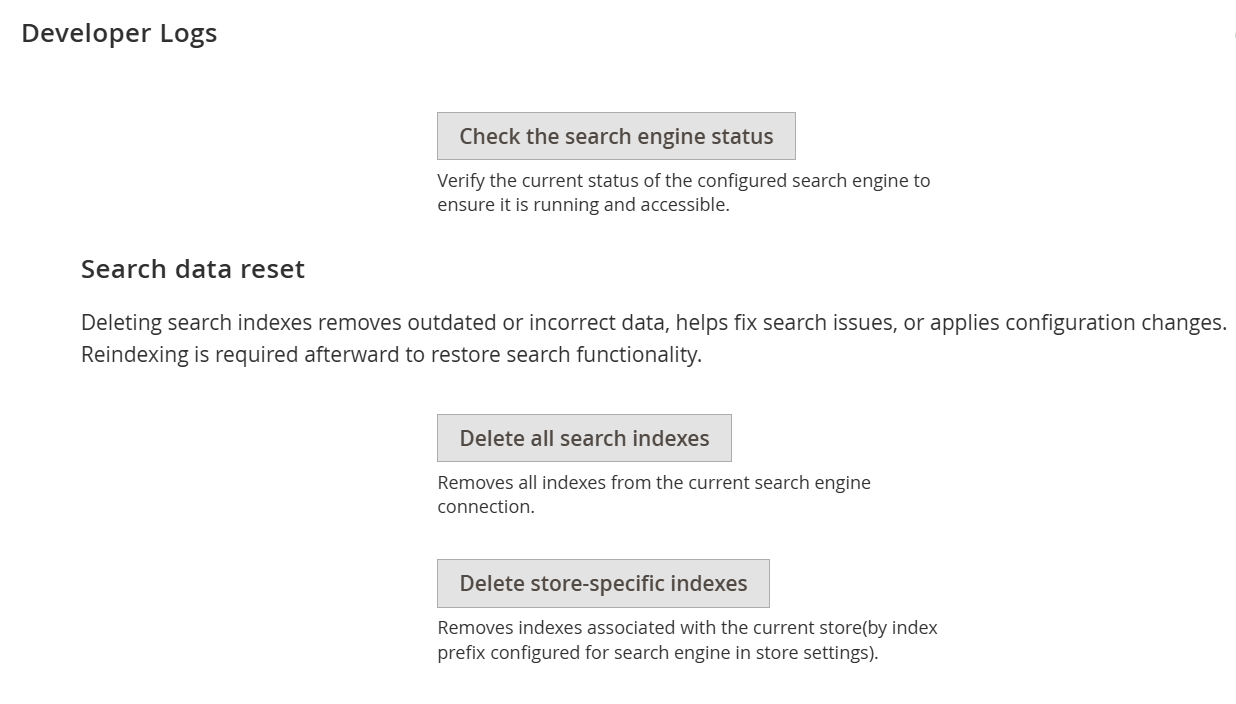
| Field | Description |
|---|---|
| Check the Search Engine Status | Verifies the current status of the configured search engine to ensure it is running and accessible. |
| Delete All Search Indexes | Removes all search indexes from the current search engine connection. This helps resolve outdated or incorrect data issues. Reindexing is required afterward. |
| Delete Store-Specific Indexes | Deletes search indexes related to the current store only, based on the configured index prefix. Reindexing is required after this action to restore search functionality. |
Advanced Search
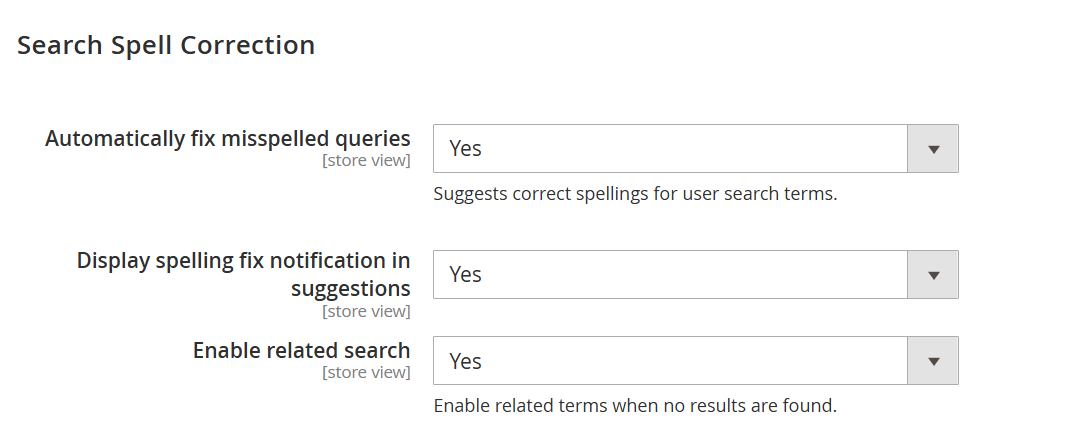
| Field | Description |
|---|---|
| Automatically fix misspelled queries | Automatically detects and corrects spelling mistakes in user search queries to improve result accuracy. |
| Display spelling fix notification in suggestions | Shows a notification or suggestion to users indicating the corrected search term. |
| Enable related search | Displays alternative or related search terms, especially when no exact results are found. |
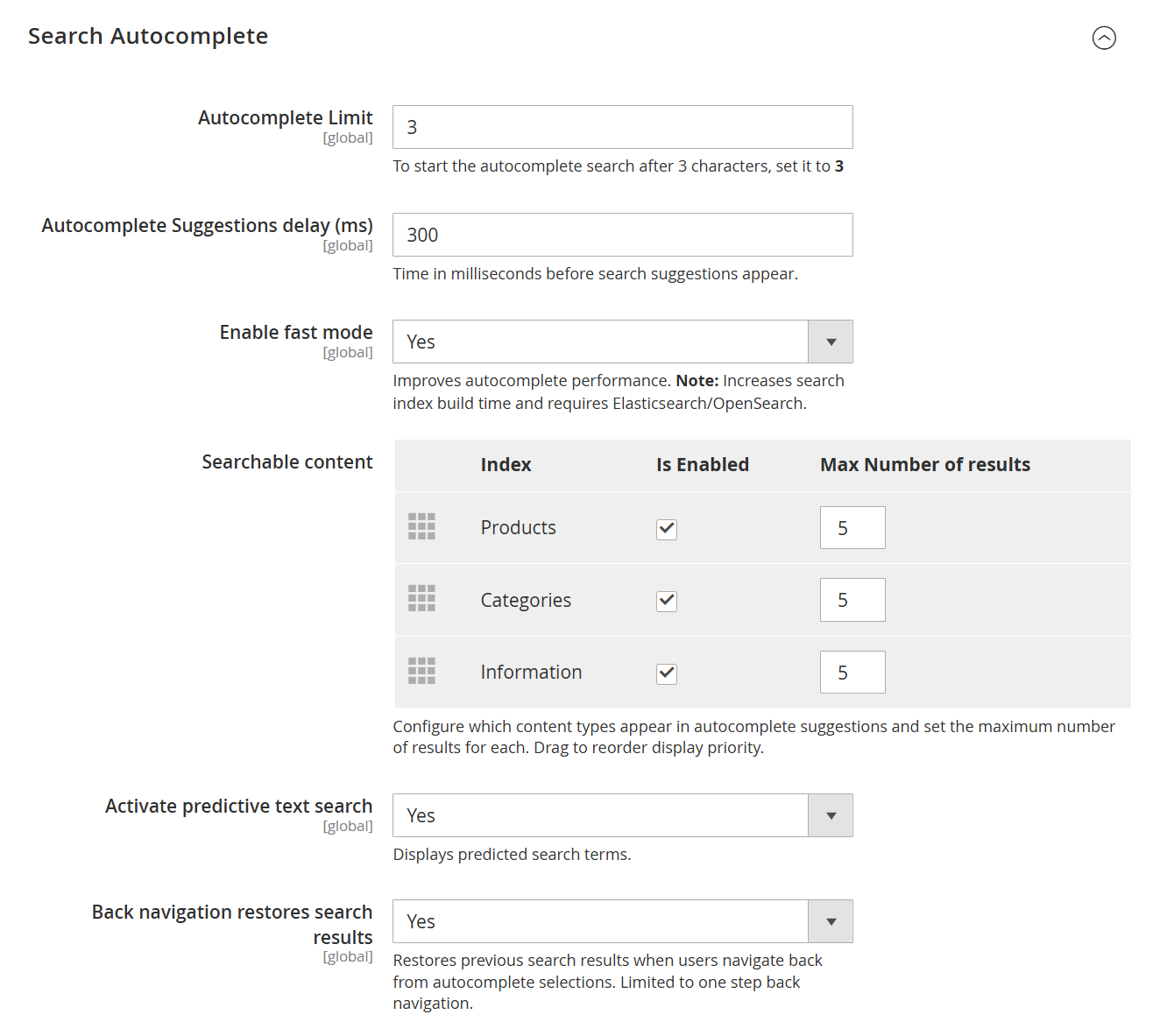
| Field | Description |
|---|---|
| Autocomplete Limit | Defines the minimum number of characters required before autocomplete suggestions start appearing. |
| Autocomplete Suggestions delay (ms) | Sets the delay (in milliseconds) before displaying search suggestions after user input. |
| Enable fast mode | Enhances autocomplete performance by using optimized indexing (requires Elasticsearch/OpenSearch). |
| Searchable content | Allows selection of content types (Products, Categories, CMS Pages) to appear in autocomplete results. |
| Is Enabled (per index) | Enables or disables specific content types in autocomplete suggestions. |
| Max Number of results | Limits the number of suggestions shown per content type in autocomplete. |
| Activate predictive text search | Displays predicted search queries based on user input. |
| Back navigation restores search results | Restores previous search results when users navigate back from autocomplete selections. |
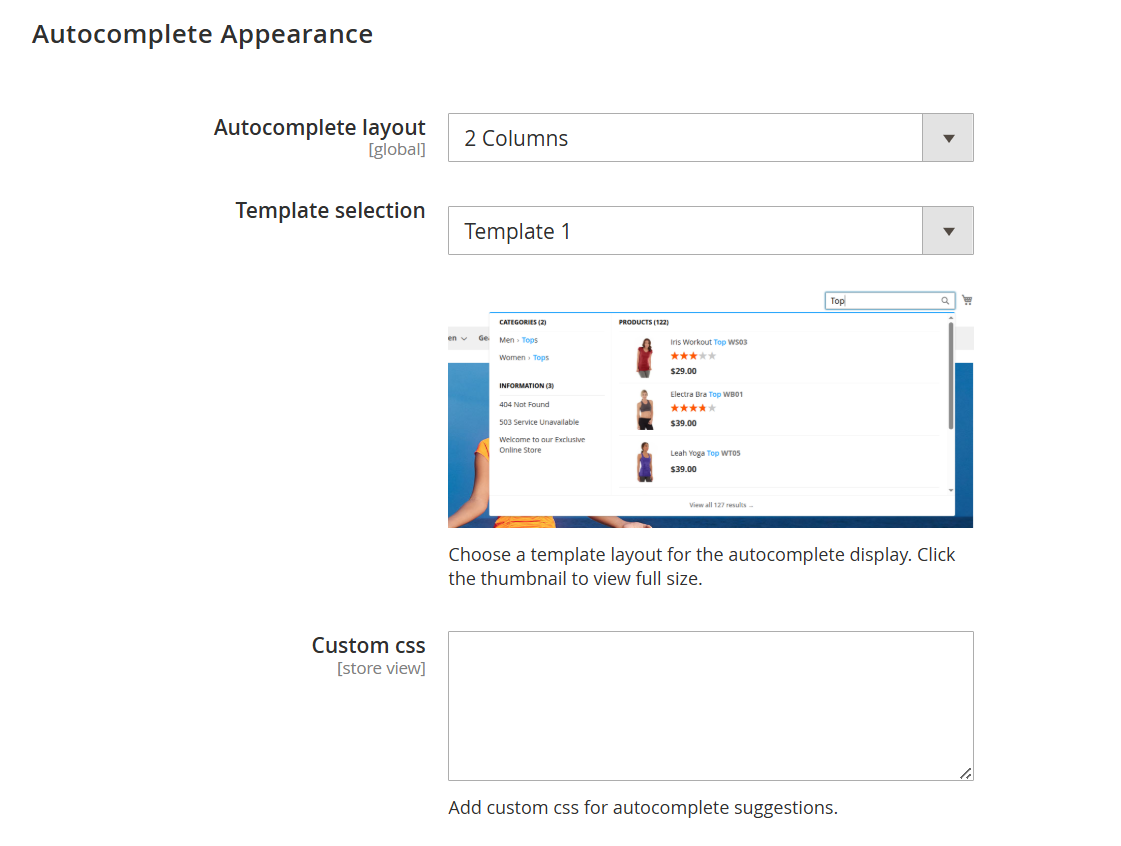
| Field | Description |
|---|---|
| Autocomplete layout | Defines how autocomplete results are displayed. Options include: 1 Column – displays results in a single vertical list; 2 Columns – splits results into two sections (commonly categories/content on one side and products on the other); Full Width Size – expands the autocomplete dropdown across the full width of the page for a broader display. |
| Template selection | Selects a predefined design template to control the look and structure of autocomplete suggestions. |
| Custom CSS | Allows adding custom CSS styles to modify the appearance of autocomplete suggestions as per store design requirements. |
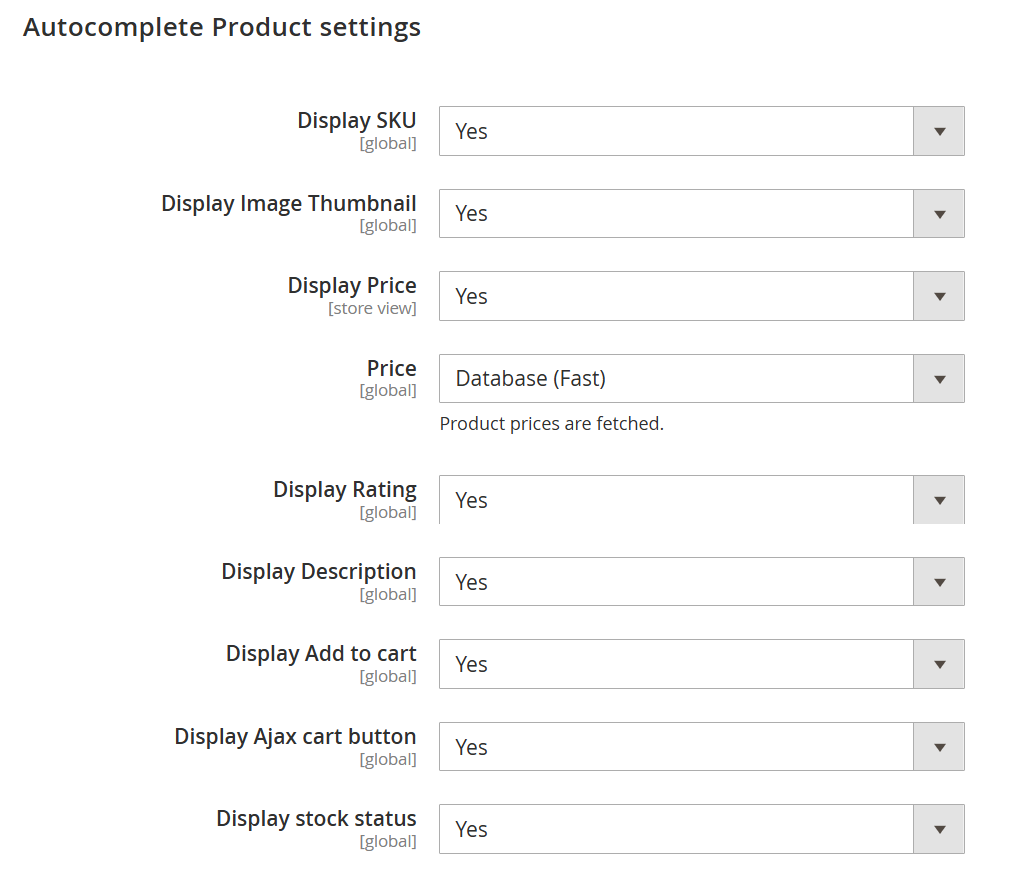
| Field | Description |
|---|---|
| Display SKU | Shows the product SKU in autocomplete suggestions for quick identification. |
| Display Image Thumbnail | Displays the product image thumbnail to provide visual context in suggestions. |
| Display Price | Enables display of product price within autocomplete results. |
| Price | Defines how product prices are fetched: Database (Fast) – retrieves price directly from index for faster performance; Magento (Final Price Only) – shows final calculated price (including discounts); Magento (Default Display) – uses Magento’s standard pricing logic (including tier/group pricing if applicable). |
| Display Rating | Displays product ratings (e.g., stars) in autocomplete suggestions. |
| Display Description | Shows a short product description to provide additional context. |
| Display Add to cart | Enables “Add to Cart” button directly within autocomplete results. |
| Display Ajax cart button | Allows adding products to cart via AJAX without page reload. |
| Display stock status | Shows product availability status (e.g., In Stock / Out of Stock). |
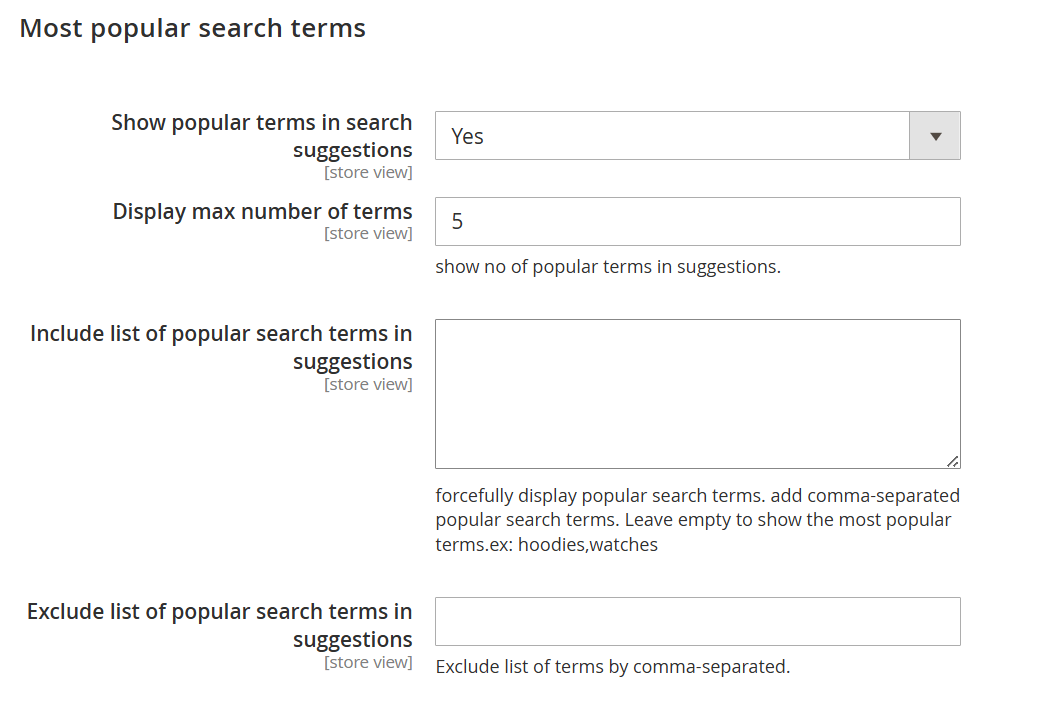
| Field | Description |
|---|---|
| Show popular terms in search suggestions | Enables displaying popular or frequently searched terms in the autocomplete dropdown. |
| Display max number of terms | Defines the maximum number of popular search terms to show in suggestions. |
| Include list of popular search terms in suggestions | Allows manually specifying search terms (comma-separated) that should always appear in suggestions. If left empty, the system automatically shows top popular terms. |
| Exclude list of popular search terms in suggestions | Allows specifying terms (comma-separated) that should be excluded from appearing in autocomplete suggestions. |
Backend Functionality
Search Indexes
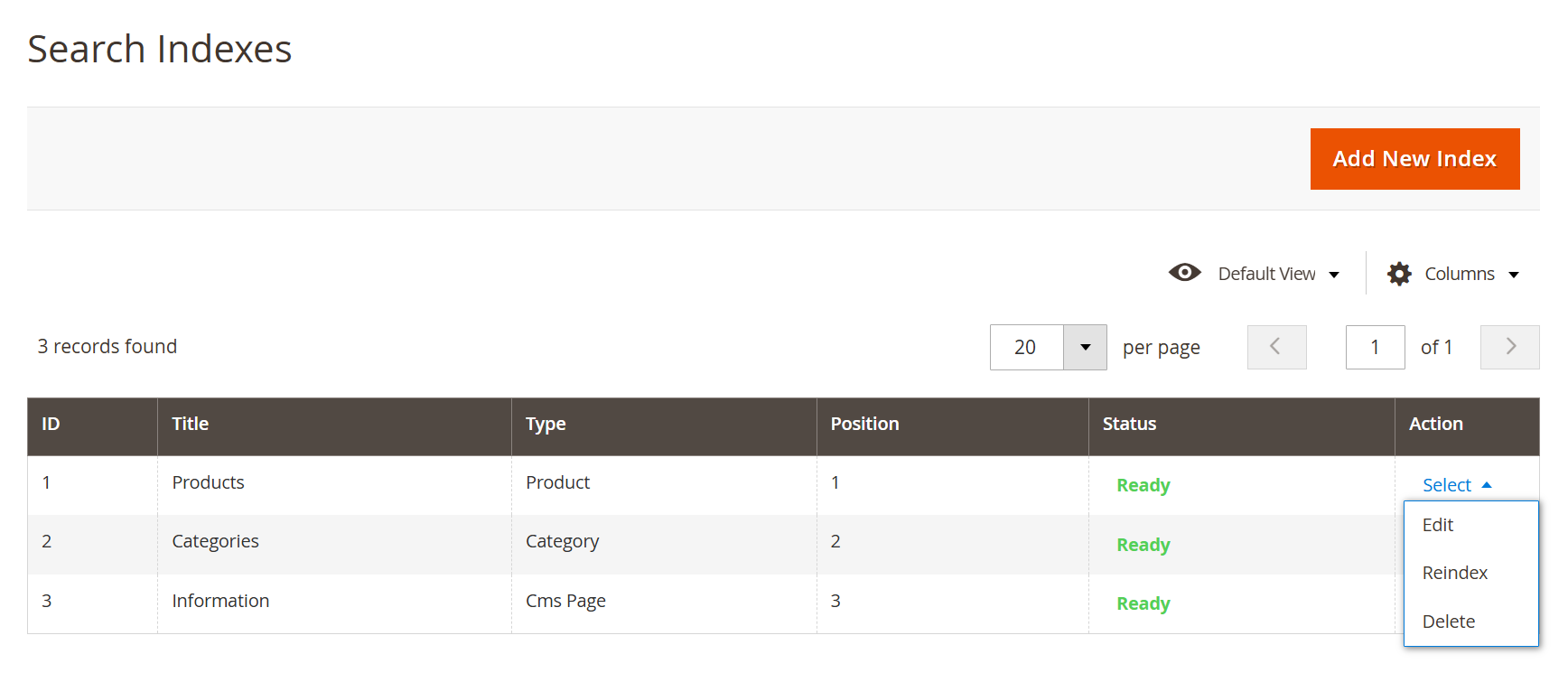
- Search Indexes allow you to manage how different types of content appear in search results. You can control indexing, update data through reindexing, and manage visibility and order of search result sections.
| Field | Description |
|---|---|
| Add New Index | Creates a new search index configuration for additional content types or custom data. |
| ID | Displays the unique identifier of the search index. |
| Title | Defines the name of the index (e.g., Products, Categories, CMS Pages). |
| Type | Indicates the type of content being indexed, such as Product, Category, or CMS Page. |
| Position | Determines the display order of indexes in search results or tabs. |
| Status | Shows the current status of the index (e.g., Ready), indicating whether it is properly indexed and available for search. |
| Action (Select) | Provides row-level actions to manage the index. |
| Edit | Allows modification of the selected search index configuration. |
| Reindex | Rebuilds the selected index to update search data and reflect recent changes. |
| Delete | Removes the selected search index from the system. |
Add New Index
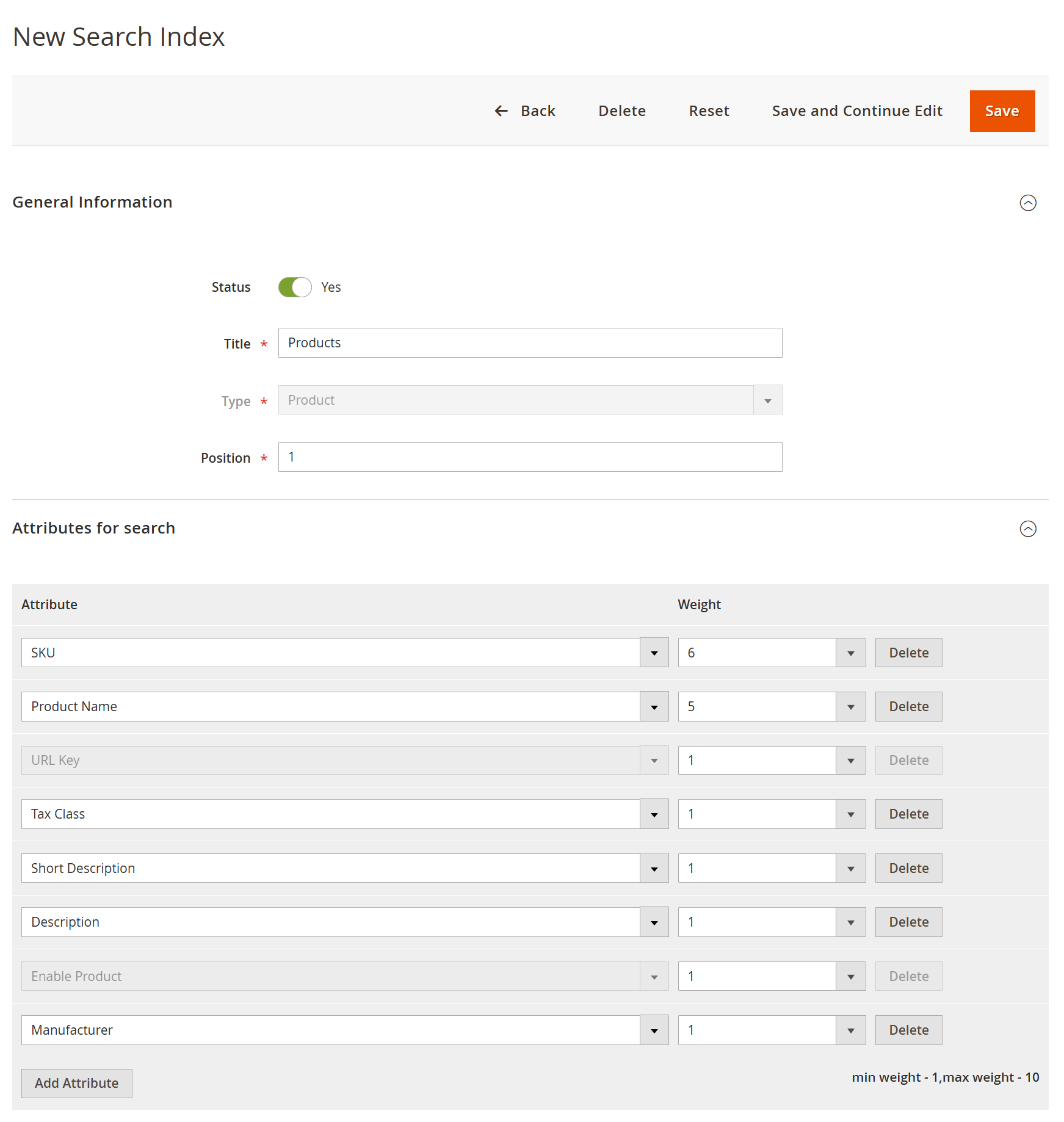
- This section allows administrators to configure how a specific content type (e.g., products) is indexed and prioritized in search results. You can control visibility, ordering, and relevance by assigning weights to different attributes.
| Field | Description |
|---|---|
| Back | Navigates back to the Search Indexes grid without saving changes. |
| Delete | Removes the current search index configuration. |
| Reset | Resets all unsaved changes and restores default values. |
| Save and Continue Edit | Saves the current configuration and allows further editing. |
| Save | Saves the search index configuration. |
| Status | Enables or disables the search index. Only enabled indexes are used in search results. |
| Title | Defines the name of the search index (e.g., Products). |
| Type | Specifies the content type being indexed (e.g., Product, Category, CMS Page). |
| Position | Determines the display order of this index in search results or tabs. |
| Attributes for Search | Lists the attributes included in search indexing and relevance calculation. |
| Attribute | Specifies the product attribute used for search matching (e.g., SKU, Name, Description). |
| Weight | Defines the importance of each attribute in search relevance. Higher values increase priority in search results. |
| Add Attribute | Allows adding additional attributes to be considered in search indexing. |
| Delete (Attribute) | Removes the selected attribute from the search configuration. |
Product Score Rules
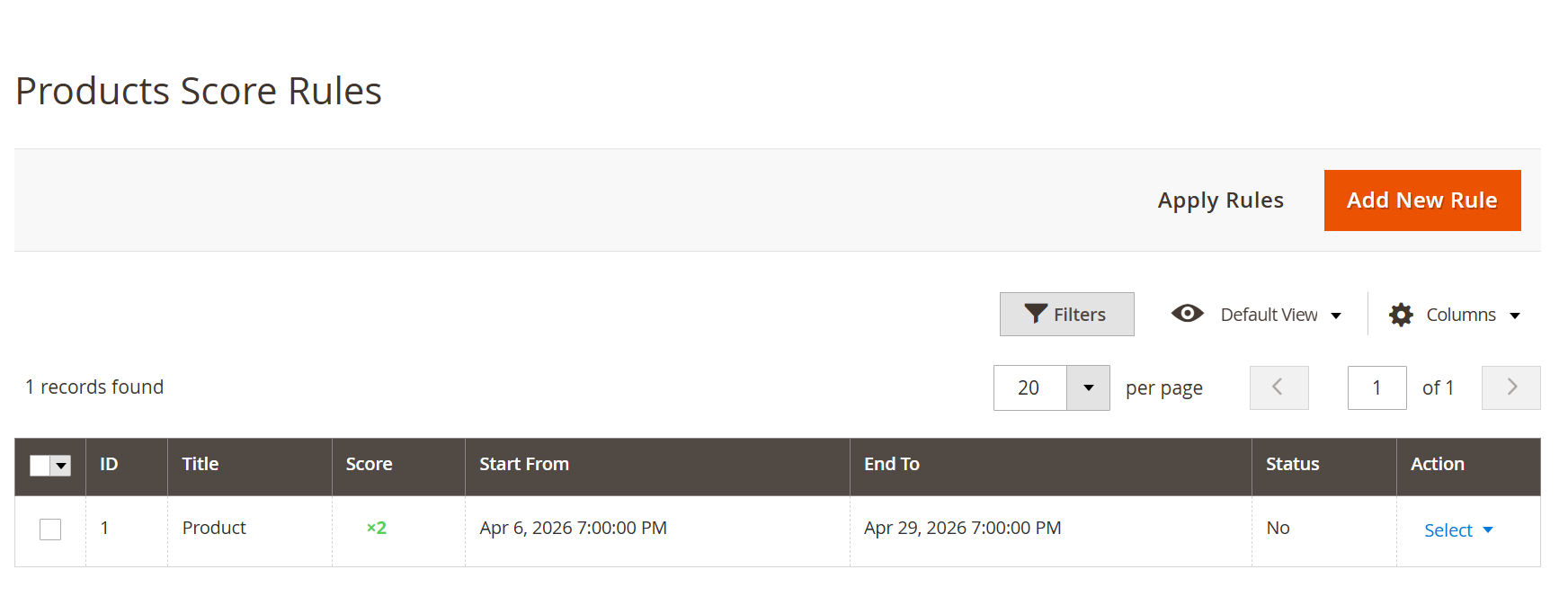
- Product Score Rules allow administrators to influence search result rankings by applying custom scoring logic. These rules help prioritize specific products dynamically based on conditions and defined time periods.
| Field | Description |
|---|---|
| Apply Rules | Applies all configured score rules to update product rankings in search results. |
| Add New Rule | Creates a new scoring rule to modify product relevance in search results. |
| ID | Displays the unique identifier of the rule. |
| Title | Defines the name of the scoring rule for easy identification. |
| Score | Specifies the score multiplier applied to matching products, affecting their ranking in search results. |
| Start From | Defines the date and time from which the rule becomes active. |
| End To | Defines the date and time until which the rule remains active. |
| Status | Indicates whether the rule is currently enabled or disabled. |
| Filters | Allows filtering the rule list based on specific criteria. |
| Default View | Enables switching between saved grid views. |
| Columns | Allows customization of visible columns in the grid. |
| Action (Select) | Provides row-level actions to manage individual rules. |
| Edit | Allows modification of the selected scoring rule. |
| Delete | Removes the selected rule from the system. |
Add New Rule
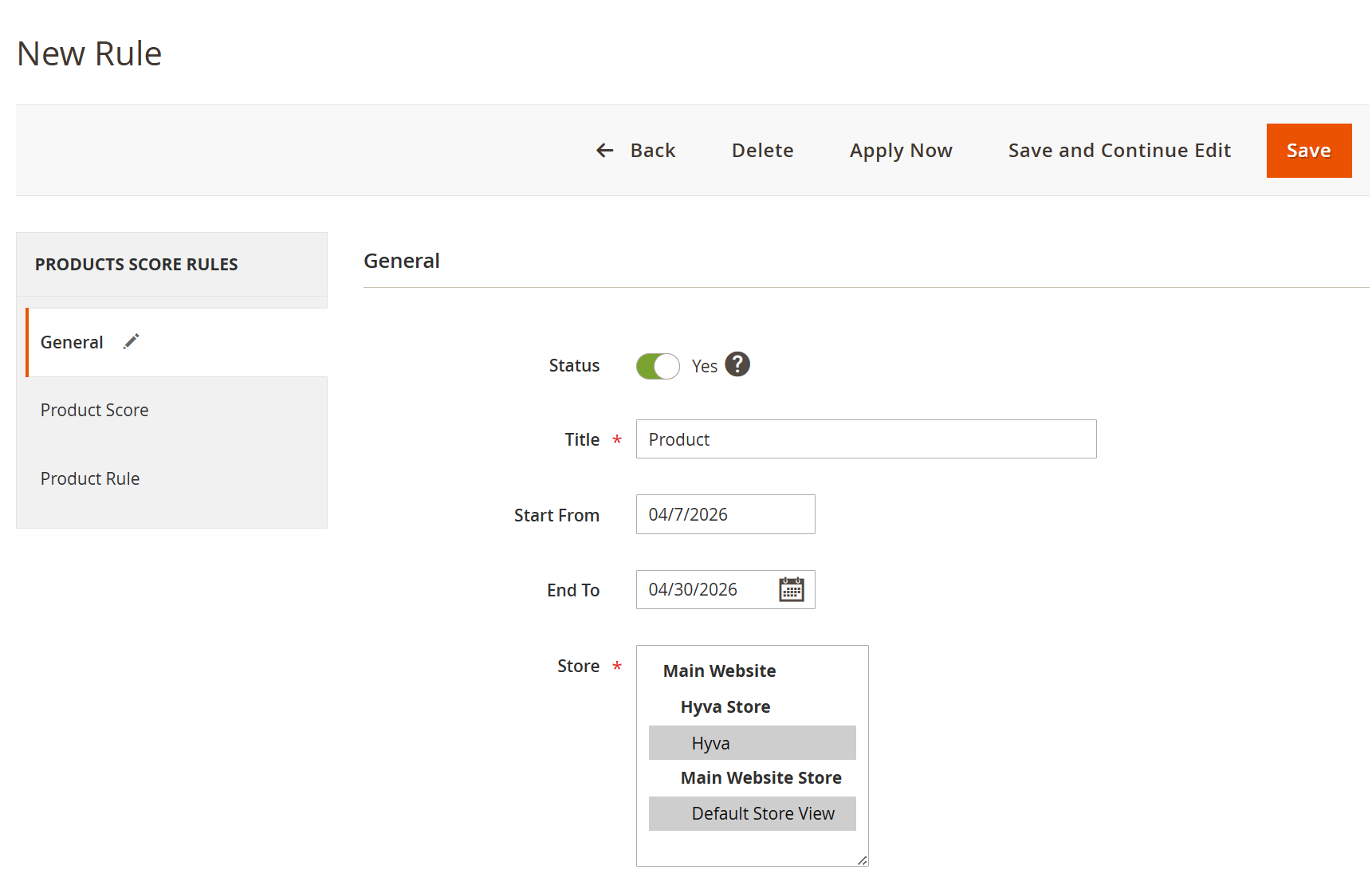
- This section allows administrators to create and manage product score rules that influence search result rankings. Rules can be scheduled, scoped per store, and applied dynamically to boost product visibility.
| Field | Description |
|---|---|
| Back | Navigates back to the rule listing page without saving changes. |
| Delete | Deletes the current rule. |
| Apply Now | Immediately applies the rule without waiting for scheduled execution. |
| Save and Continue Edit | Saves the rule and allows further modifications. |
| Save | Saves the rule configuration. |
| Status | Enables or disables the rule. Only active rules affect search results. |
| Title | Defines the name of the rule for identification. |
| Start From | Specifies the date from which the rule becomes active. |
| End To | Specifies the date until which the rule remains active. |
| Store | Defines the store views where the rule will be applied. |
| General (Section) | Contains basic rule configuration such as status, scheduling, and store scope. |
| Product Score | Allows defining scoring logic to boost or adjust product ranking. |
| Product Rule | Defines conditions to determine which products the rule will apply to. |
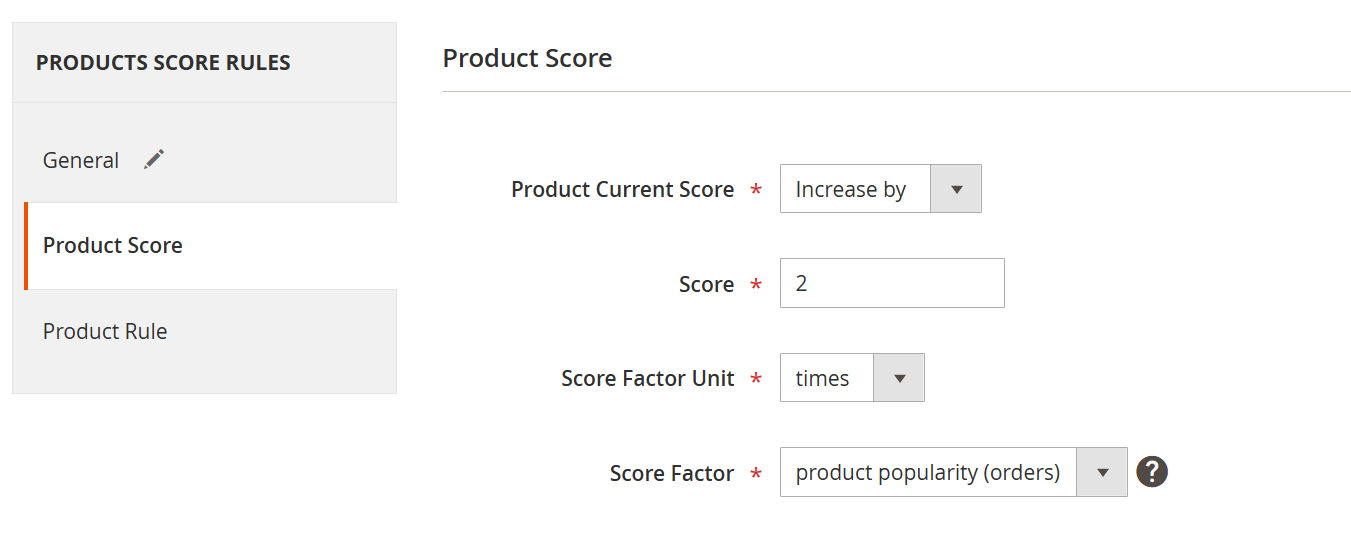
- Product score allows administrators to control how product ranking is adjusted in search results by applying scoring logic. You can increase or decrease product visibility dynamically based on selected factors such as popularity or ratings.
| Field | Description |
|---|---|
| Product Current Score | Defines whether the product score should be increased or decreased based on the applied rule. |
| Score | Specifies the value used to adjust the product score. |
| Score Factor Unit | Determines how the score value is applied, either as a multiplier (times) or as a fixed addition (points). |
| Score Factor | Selects the basis for score calculation, such as initial score, product popularity (orders), or product rating (reviews). |
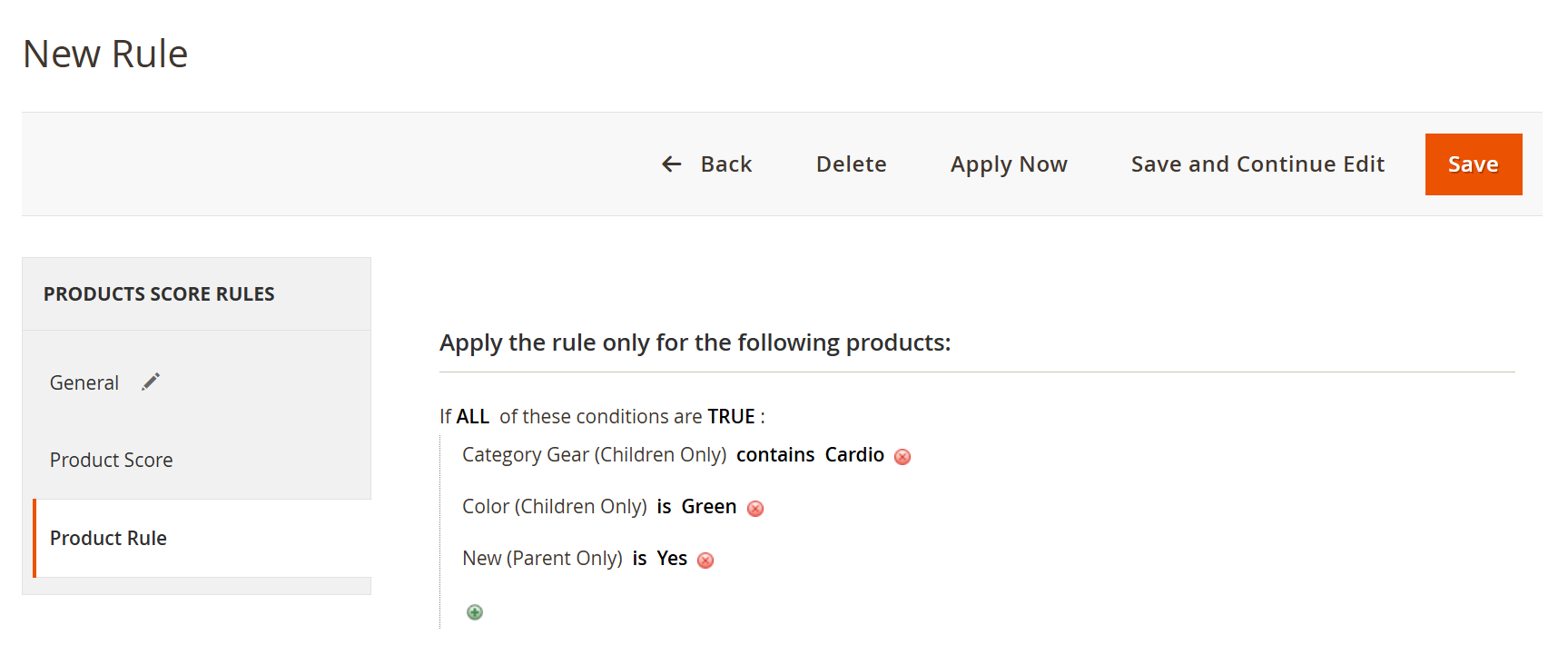
- Product rule allows administrators to define conditions to control which products the scoring rule will apply to. Rules are applied only to products that match all specified conditions, enabling targeted ranking adjustments.
| Field | Description |
|---|---|
| Apply the Rule Only for the Following Products | Defines the scope of products to which the rule will be applied based on specified conditions. |
| Conditions (If ALL of These Conditions Are TRUE) | Ensures that the rule is applied only when all defined conditions are satisfied. |
| Attribute Condition | Specifies the product attribute used for filtering (e.g., Category, Color, New). |
| Operator | Defines how the condition is evaluated (e.g., contains, is, equals). |
| Value | Specifies the value that the attribute must match for the condition to be true. |
| Add Condition (+) | Allows adding additional conditions to refine product selection. |
| Delete Condition | Removes an existing condition from the rule. |
Search Synonyms
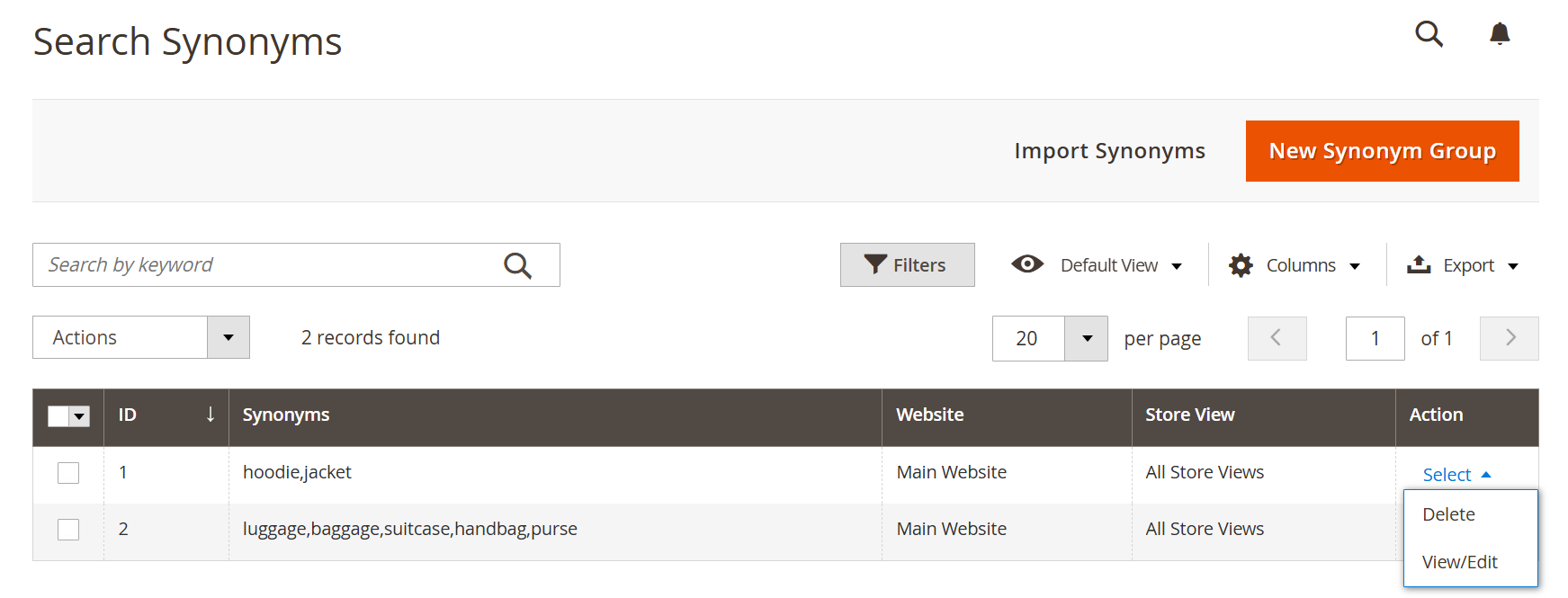
- This section allows administrators to manage synonym groups to improve search accuracy and relevance. It ensures that different keywords with similar meanings return consistent search results
| Field | Description |
|---|---|
| Import Synonyms | Allows bulk import of synonym groups using a predefined format. |
| New Synonym Group | Creates a new group of related keywords that will be treated as equivalent in search queries. |
| Search by Keyword | Enables quick searching of existing synonym groups. |
| Actions | Allows performing bulk actions on selected synonym groups. |
| ID | Displays the unique identifier of the synonym group. |
| Synonyms | Lists the grouped keywords that are treated as interchangeable in search queries. |
| Website | Indicates the website scope where the synonym group is applied. |
| Store View | Specifies the store views where the synonym group is active. |
| Action (Select) | Provides row-level actions for managing synonym groups. |
| View/Edit | Allows viewing or modifying the selected synonym group. |
| Delete | Removes the selected synonym group from the system. |
Add New Synonym Group
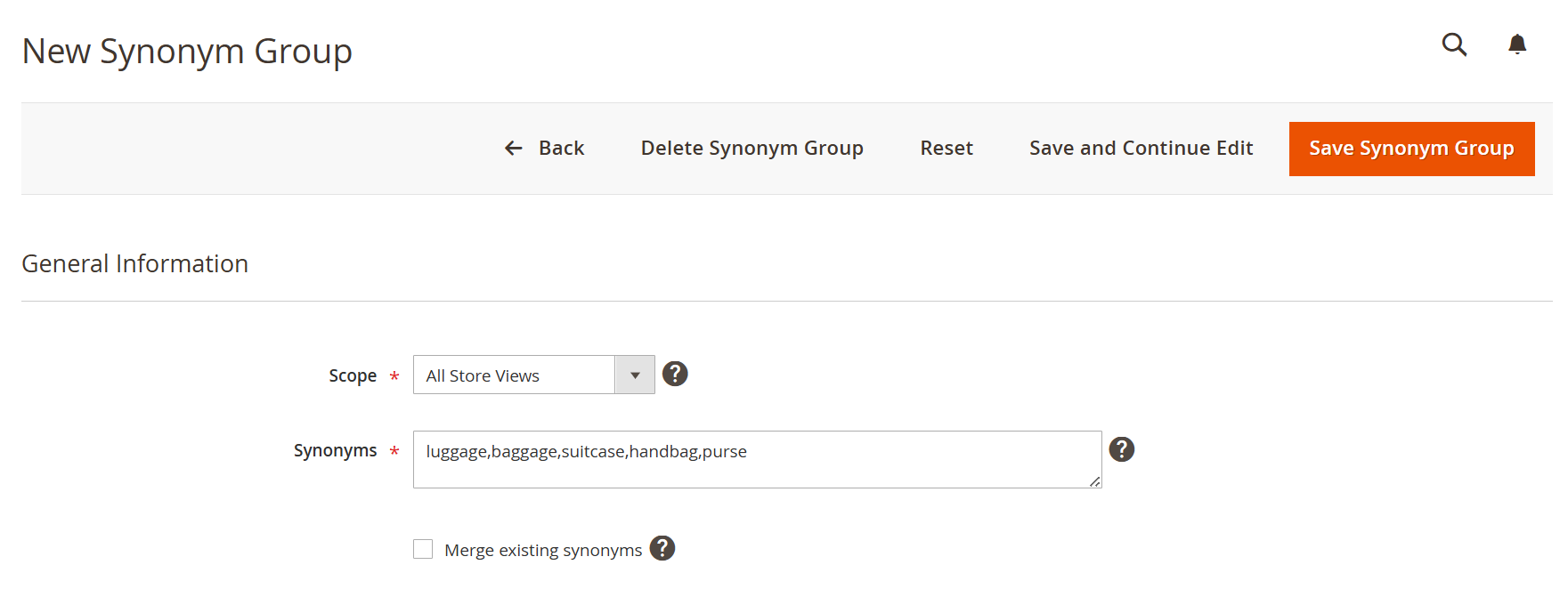
- This section allows administrators to create and manage groups of related keywords that are treated as equivalent in search queries. It helps improve search accuracy by ensuring users find relevant results even when using different terms.
| Field | Description |
|---|---|
| Back | Navigates back to the synonym group listing page without saving changes. |
| Delete Synonym Group | Deletes the current synonym group. |
| Reset | Clears all unsaved changes and restores default values. |
| Save and Continue Edit | Saves the synonym group and allows further modifications. |
| Save Synonym Group | Saves the newly created synonym group. |
| Scope | Defines the store view or website scope where the synonym group will be applied. |
| Synonyms | Specifies a list of keywords separated by commas that will be treated as interchangeable in search queries. |
| Merge Existing Synonyms | Merges the entered synonyms with any existing groups instead of creating duplicates. |
| General Information | Section containing basic configuration for synonym group creation. |
Manage Stopwords
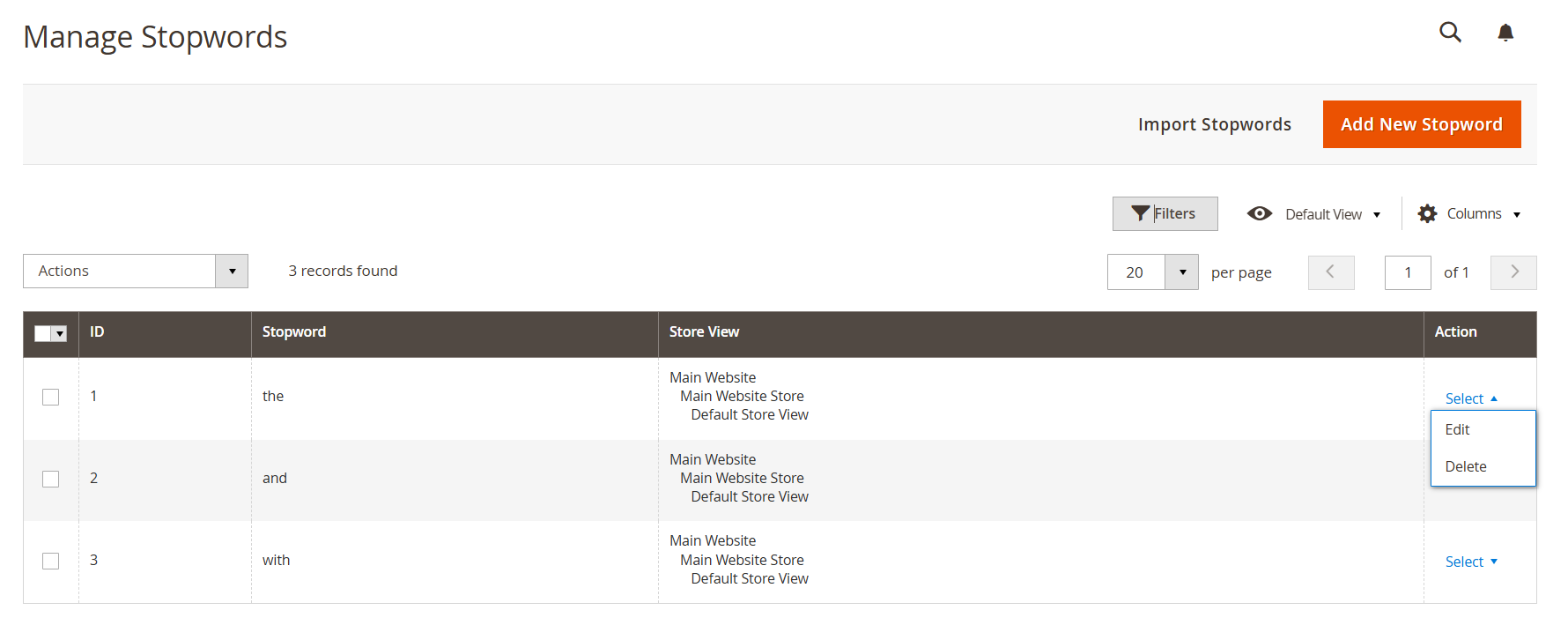
| Field | Description |
|---|---|
| Stopwords | Defines common words (e.g., the, and, with) that should be ignored during search queries to improve relevance. |
| Add New Stopword | Allows administrators to manually add new stopwords that should be excluded from search processing. |
| Import Stopwords | Enables bulk upload of stopwords for faster configuration and management. |
| Store View | Specifies the store view where the stopword rule will be applied, supporting multi-store configurations. |
| Edit | Allows modification of an existing stopword entry. |
| Delete | Removes a stopword from the list so it will be considered again in search queries. |
| Filters & Grid | Helps manage and view stopwords efficiently using filters, pagination, and column controls. |
Add New Stopword
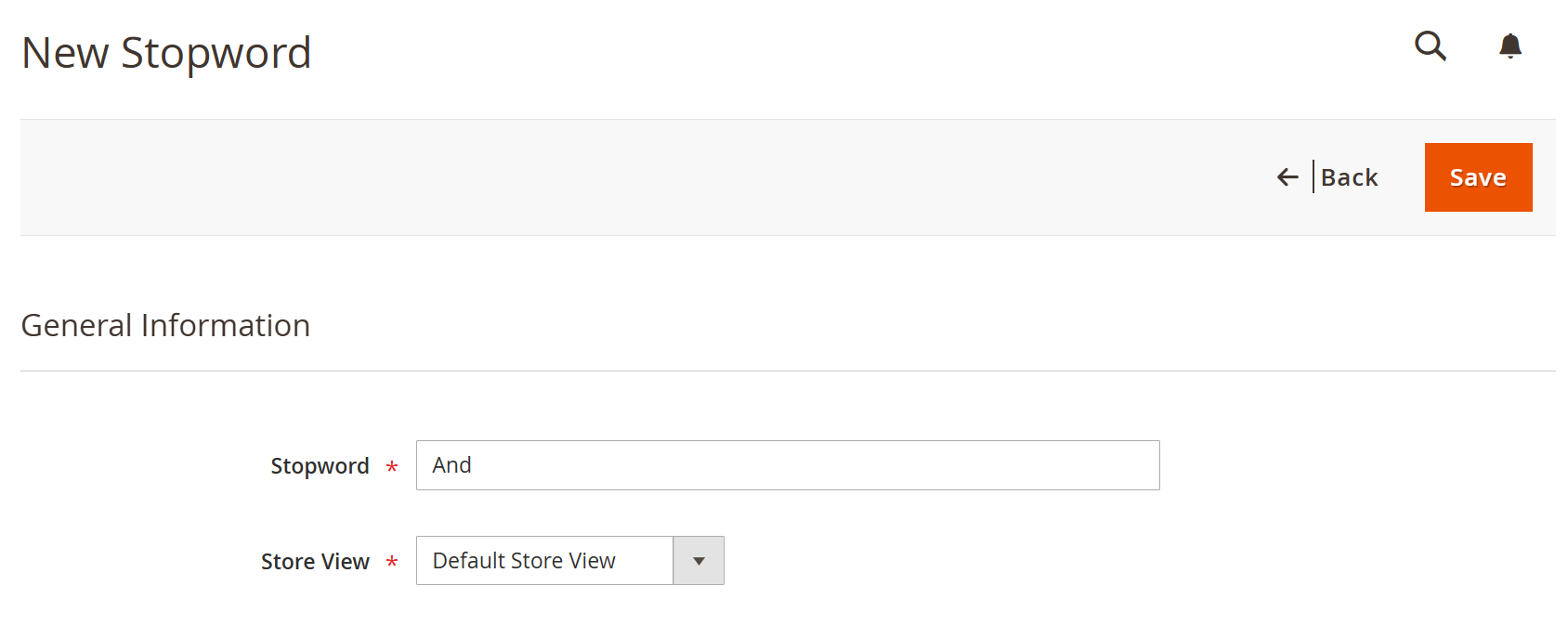
| Field | Description |
|---|---|
| Stopword | Enter the word that should be ignored during search queries (e.g., and, the, with) to improve result relevance. |
| Store View | Select the store view where this stopword will be applied, allowing store-specific search optimization. |
| Save | Saves the stopword configuration and applies it to the search processing. |
| Back | Returns to the stopwords grid without saving changes. |
Validate Search
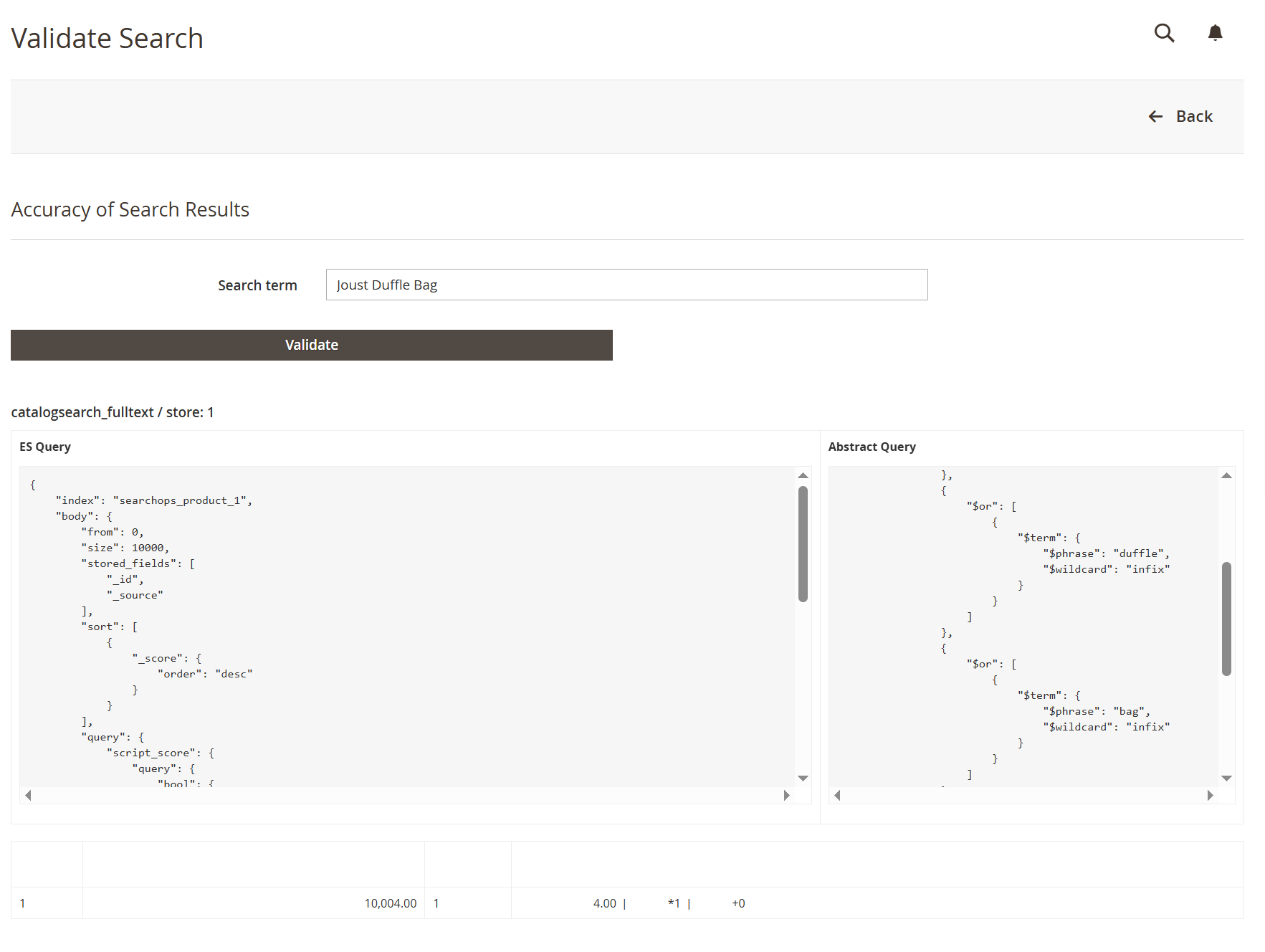
- This section allows administrators to test and analyze how search queries are processed and executed. It helps validate search accuracy, debug query behavior, and understand how results are generated.
| Field | Description |
|---|---|
| Search Term | Enter the keyword or phrase to test how it performs in search results. |
| Validate | Executes the search query and displays detailed results and query analysis. |
| Catalogsearch Fulltext / Store | Indicates the search index and store view used for validation. |
| ES Query | Displays the actual Elasticsearch/OpenSearch query generated by the system for the entered search term. |
| Abstract Query | Shows a simplified representation of how the search query is interpreted internally. |
| Search Results Data | Displays the resulting data along with scoring details used to rank products. |
| Back | Navigates back to the previous page. |
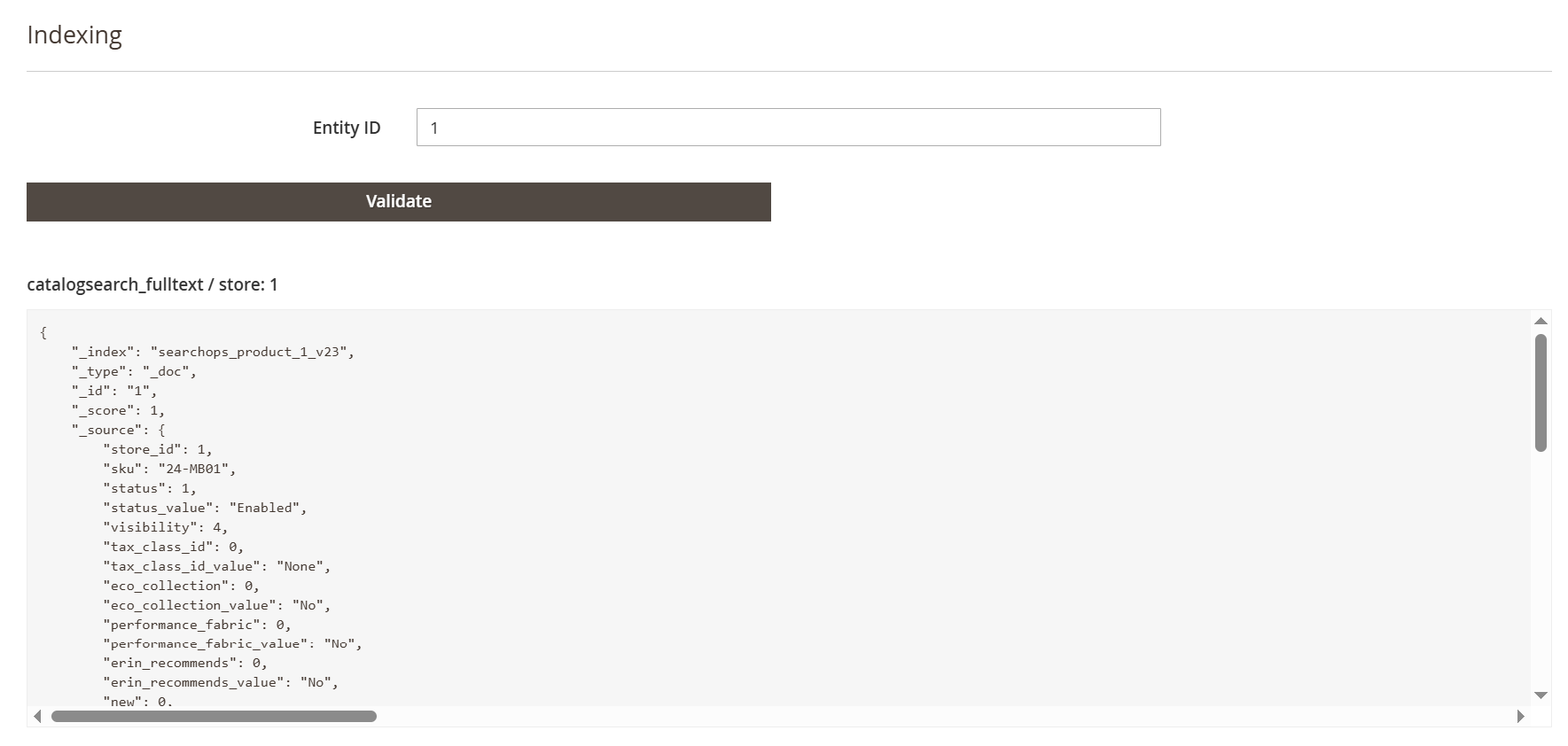
- This section allows administrators to validate how a specific entity (e.g., product) is indexed in the search engine. It helps inspect indexed data, verify attribute values, and troubleshoot indexing or search-related issues.
| Field | Description |
|---|---|
| Entity ID | Enter the ID of the entity (e.g., product ID) to validate its indexed data. |
| Validate | Executes the validation process and retrieves indexed data from the search engine. |
| Catalogsearch Fulltext / Store | Indicates the search index and store view used for validation. |
| Indexed Data (JSON View) | Displays the raw indexed data stored in the search engine, including all attributes and values for the entity. |
| _index / _type / _id | Shows technical identifiers of the indexed record in the search engine. |
| _score | Represents the relevance score assigned to the entity during search. |
| _source | Contains the full set of indexed attribute data used for search queries. |
Search Landing Pages
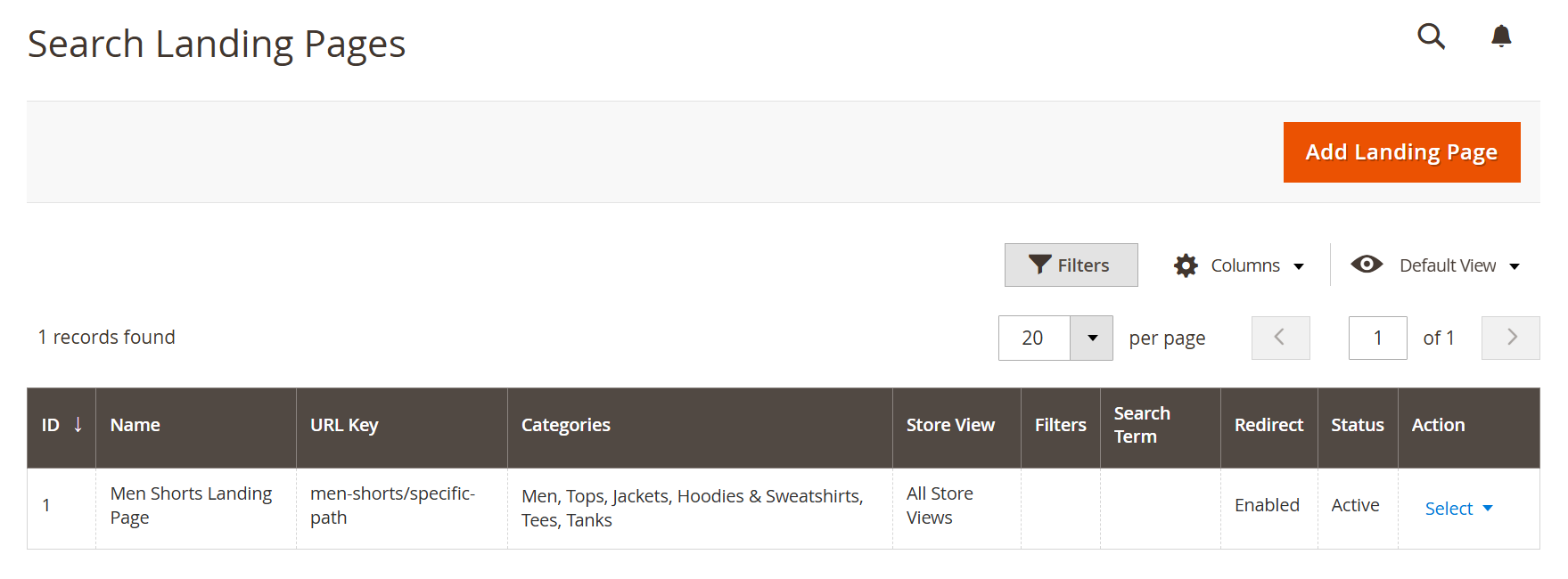
- This section allows administrators to create dedicated landing pages for specific search queries or categories. It helps optimize search experience by redirecting users to curated pages with predefined filters and content.
| Field | Description |
|---|---|
| Add Landing Page | Creates a new search landing page with custom configuration. |
| ID | Displays the unique identifier of the landing page. |
| Name | Defines the name of the landing page for internal reference. |
| URL Key | Specifies the SEO-friendly URL path for the landing page. |
| Categories | Assigns categories to control which products are displayed on the landing page. |
| Store View | Defines the store views where the landing page is available. |
| Filters | Displays applied filters used to refine product results on the landing page. |
| Search Term | Defines the keyword that triggers this landing page. |
| Redirect | Indicates whether search queries will redirect users to this landing page. |
| Status | Shows whether the landing page is active or inactive. |
| Action (Select) | Provides row-level actions to manage landing pages. |
| Edit | Allows modification of the landing page configuration. |
| Delete | Removes the selected landing page. |
Add Landing Page
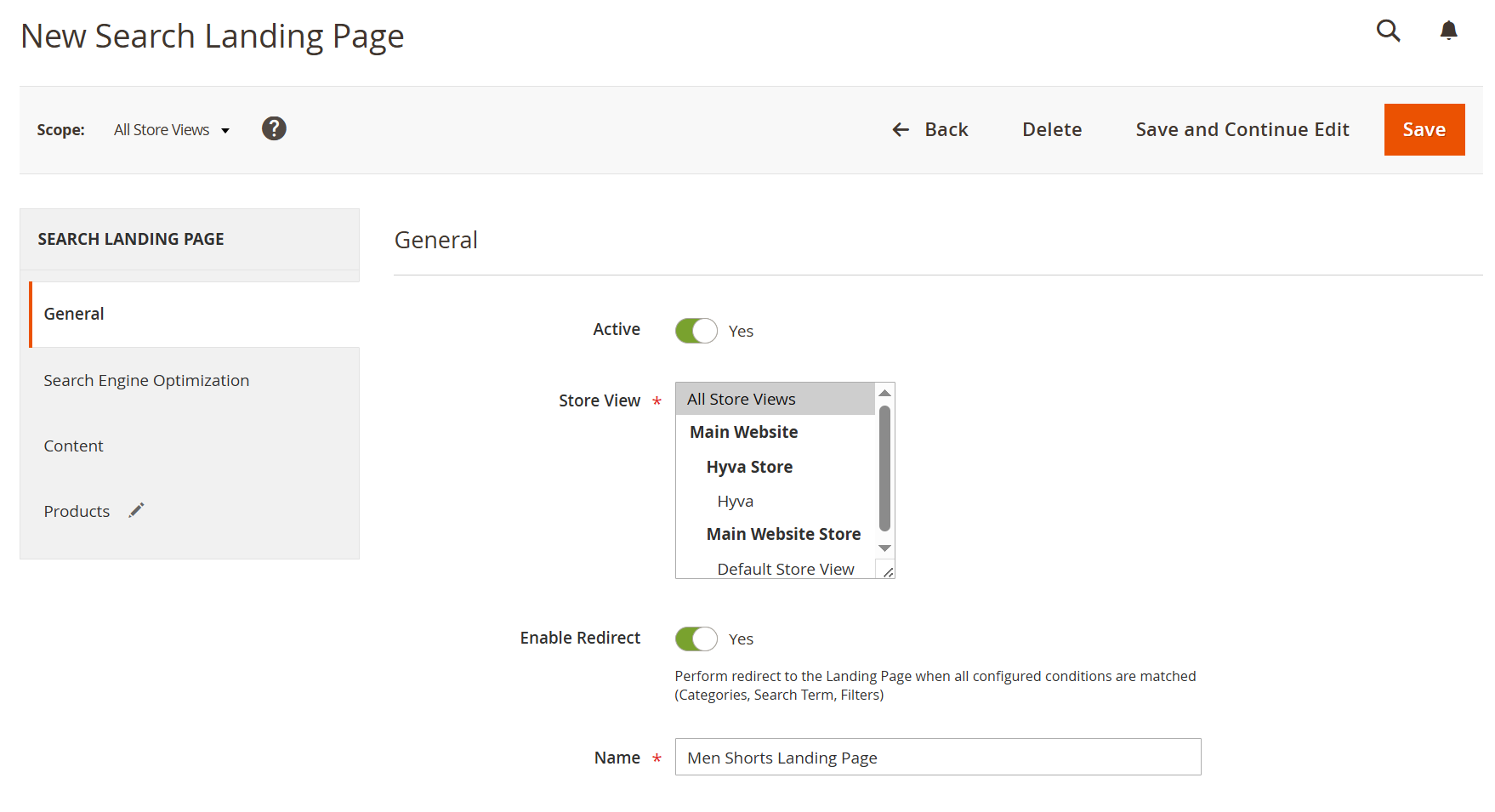
- After clicking on Add Landing Page, a new configuration page opens where administrators can define the landing page behavior, visibility, and redirection rules. This setup ensures targeted search experiences based on specific conditions.
| Field | Description |
|---|---|
| Back | Navigates back to the landing page listing without saving changes. |
| Delete | Deletes the current landing page. |
| Save and Continue Edit | Saves the configuration and allows further editing. |
| Save | Saves the landing page configuration. |
| Active | Enables or disables the landing page. Only active pages are visible on the storefront. |
| Store View | Defines the store views where the landing page will be available. |
| Enable Redirect | Redirects users to this landing page when configured conditions (such as search term, category, or filters) are met. |
| Name | Specifies the internal name of the landing page for identification. |
| General (Section) | Contains core configuration settings such as status, store scope, and redirect behavior. |
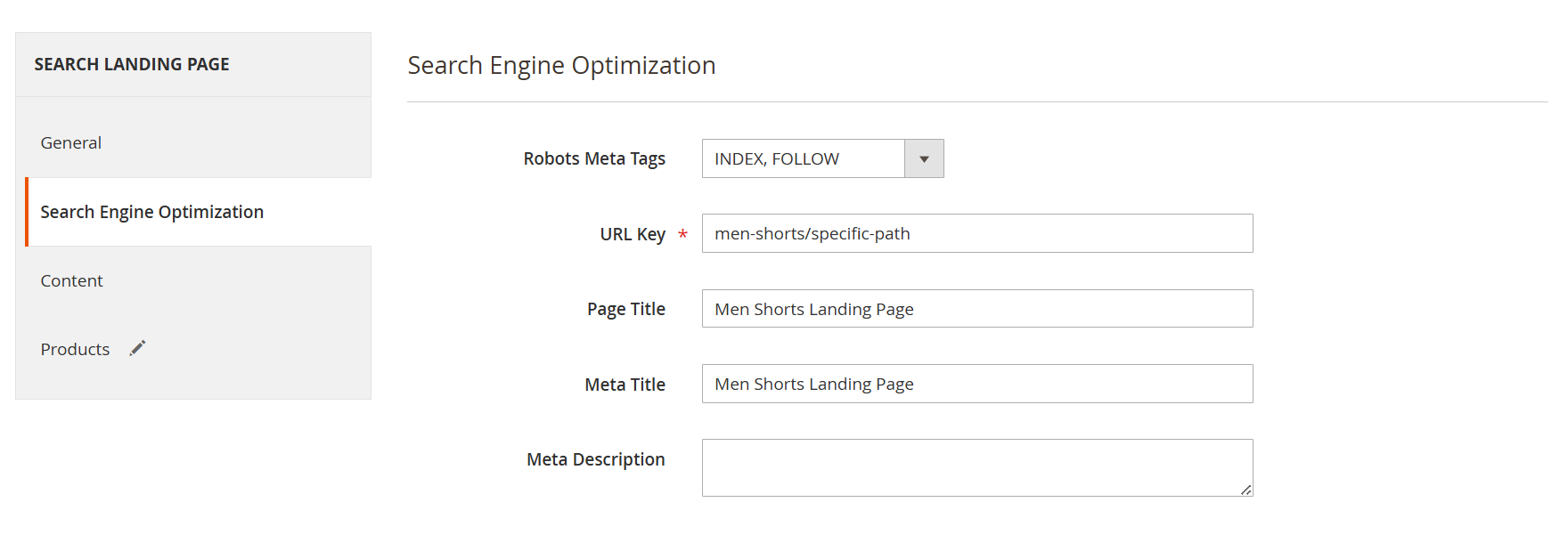
- This section allows administrators to configure SEO-related settings for the landing page, ensuring better visibility in search engines. It helps optimize how the page appears in search results and improves discoverability.
| Field | Description |
|---|---|
| Robots Meta Tags | Defines how search engines should crawl and index the page (e.g., INDEX, FOLLOW). |
| URL Key | Specifies the SEO-friendly URL path for the landing page. |
| Page Title | Defines the title displayed on the browser tab and search results. |
| Meta Title | Specifies the SEO title used by search engines. |
| Meta Description | Provides a brief description of the page for search engine listings. |
| Search Engine Optimization (Section) | Contains SEO configuration settings to improve search engine ranking and visibility. |
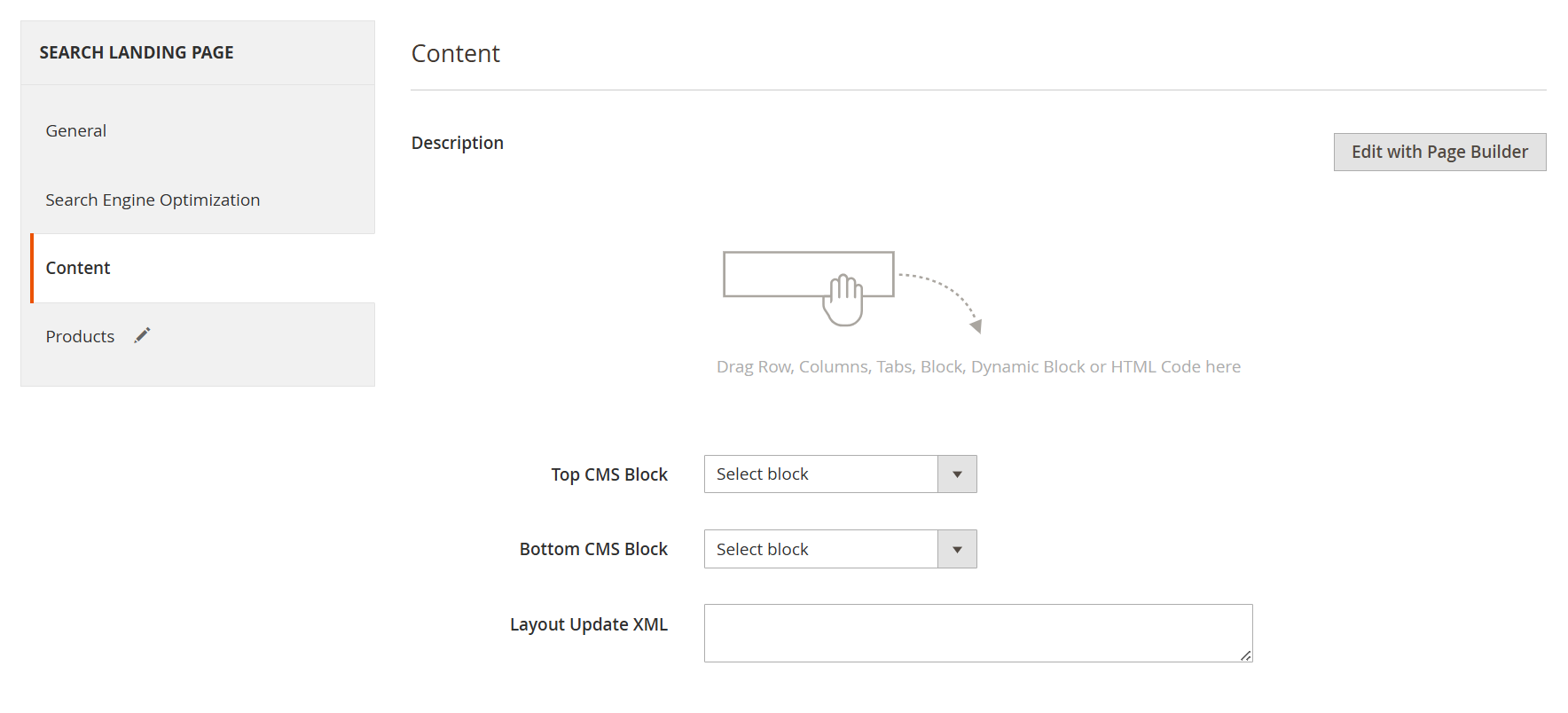
- This section allows administrators to design and manage the visual and informational content of the landing page. It helps create a customized user experience by adding descriptions, CMS blocks, and layout updates.
| Field | Description |
|---|---|
| Description | Allows adding custom content for the landing page using Page Builder or HTML. |
| Edit with Page Builder | Opens the Page Builder interface to design and structure page content visually. |
| Top CMS Block | Selects a CMS block to display at the top of the landing page. |
| Bottom CMS Block | Selects a CMS block to display at the bottom of the landing page. |
| Layout Update XML | Allows adding custom XML code to modify the layout and structure of the landing page. |
| Content (Section) | Contains all settings related to managing and displaying landing page content. |
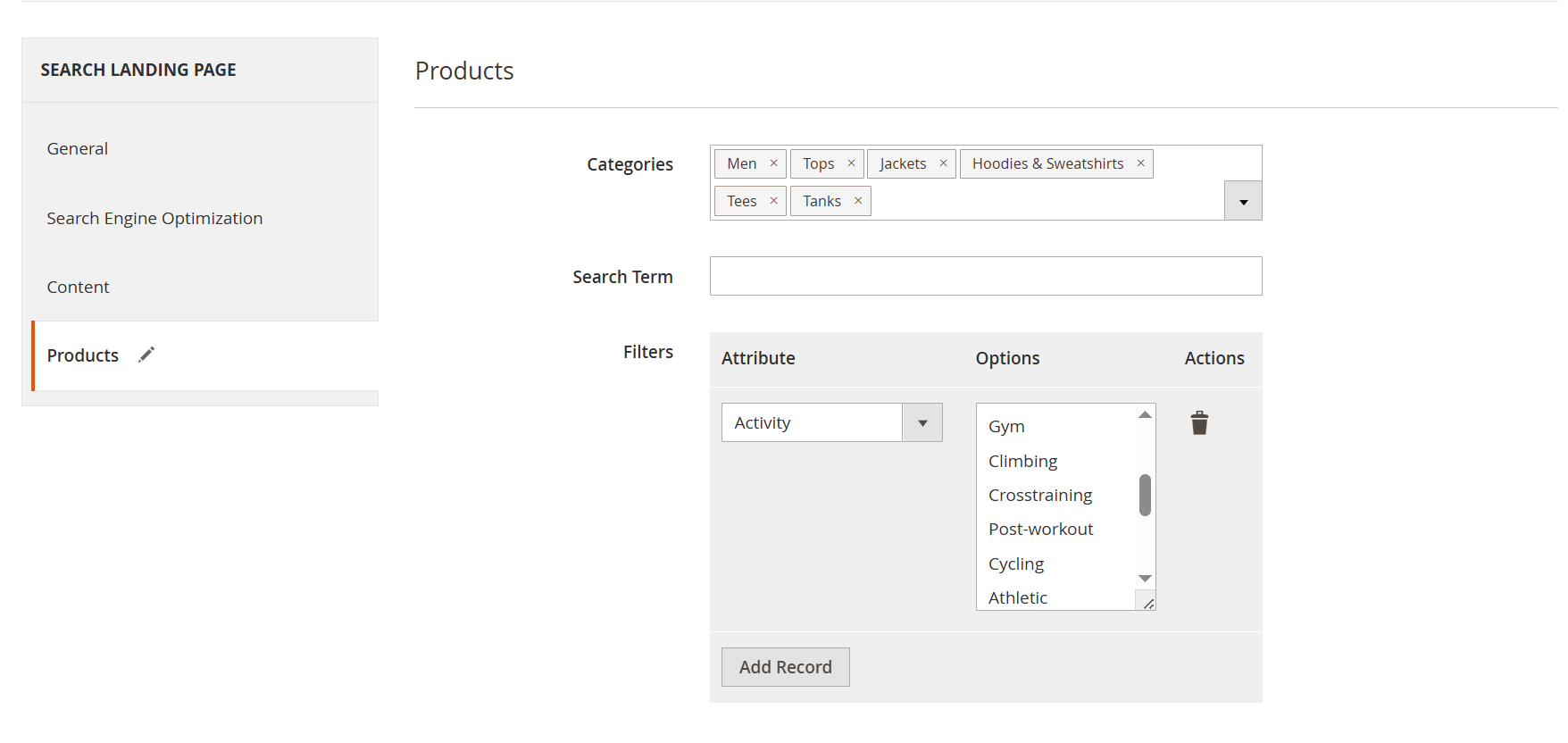
- This section allows administrators to define which products will appear on the landing page based on categories, search terms, and attribute-based filters. It helps create targeted product listings for specific search experiences.
| Field | Description |
|---|---|
| Categories | Selects the categories from which products will be displayed on the landing page. |
| Search Term | Defines the keyword that triggers this landing page when searched by users. |
| Filters | Allows applying attribute-based conditions to refine the product collection displayed on the landing page. |
| Attribute | Specifies the product attribute used for filtering (e.g., Activity, Color). |
| Options | Defines the attribute values that products must match to be included. |
| Actions (Delete) | Removes the selected filter condition. |
| Add Record | Adds a new filter condition to further refine product selection. |
| Products (Section) | Contains all configurations related to selecting and filtering products for the landing page. |
Search Volume Report
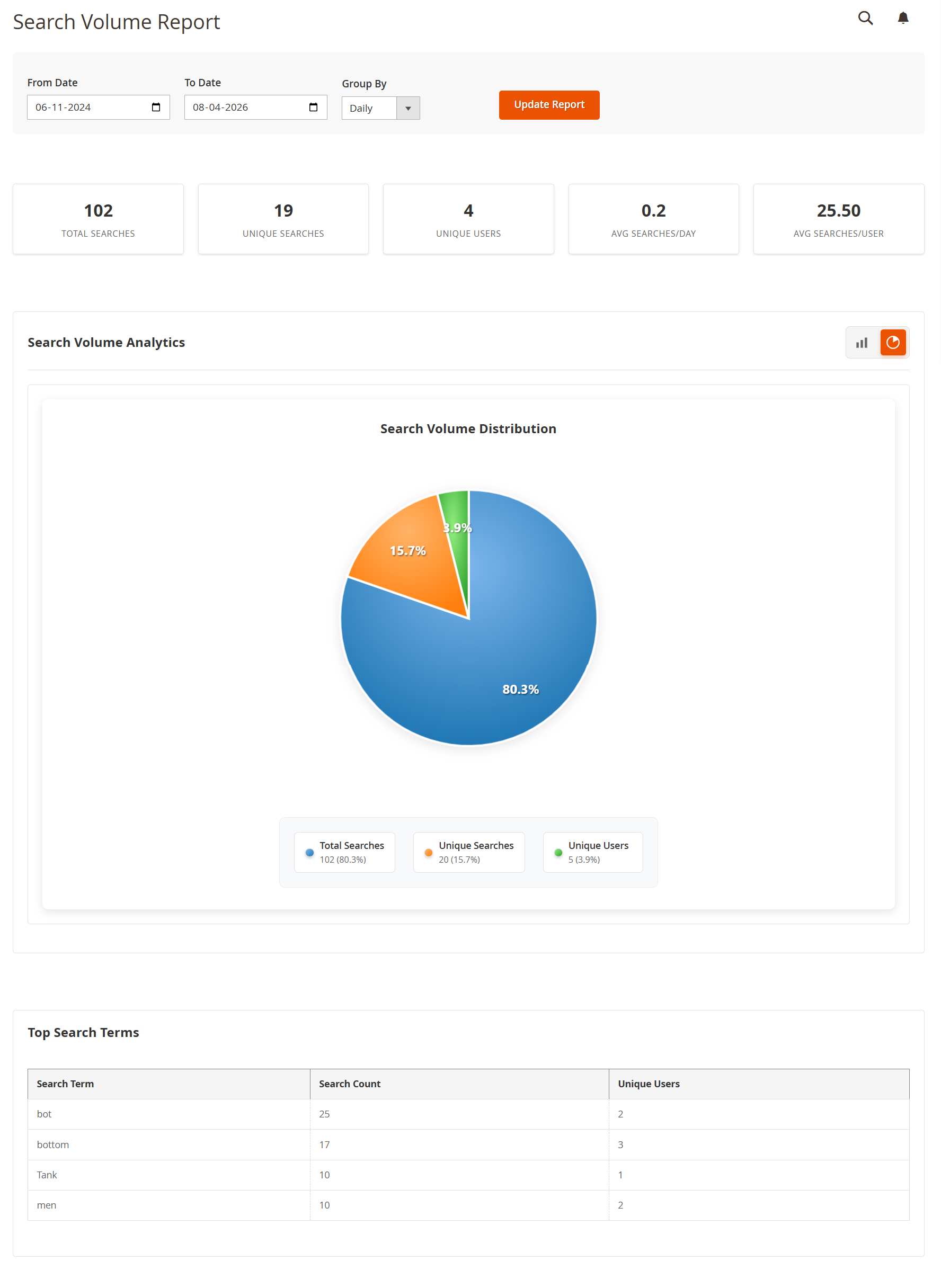
- This report provides insights into how users interact with search on the store, including search frequency, user behavior, and popular search terms. It helps administrators analyze trends and optimize search performance and product visibility.
| Field | Description |
|---|---|
| From Date | Defines the start date for generating the search report data. |
| To Date | Defines the end date for the search report data range. |
| Group By | Groups the report data by a selected time interval (e.g., daily). |
| Update Report | Refreshes and generates the report based on selected filters. |
| Total Searches | Displays the total number of searches performed within the selected period. |
| Unique Searches | Shows the number of distinct search queries entered by users. |
| Unique Users | Indicates the number of individual users who performed searches. |
| Avg Searches/Day | Calculates the average number of searches performed per day. |
| Avg Searches/User | Shows the average number of searches performed per user. |
| Search Volume Analytics | Visual representation (chart) showing distribution of search activity. |
| Search Volume Distribution | Displays percentage breakdown of total searches, unique searches, and users. |
| Top Search Terms | Lists the most frequently searched keywords along with usage metrics. |
| Search Count | Number of times a specific search term was used. |
| Unique Users (per term) | Number of distinct users who searched for a specific term. |
Frontend Functionality
Autocomplete Products Search Display (1-Column Layout)
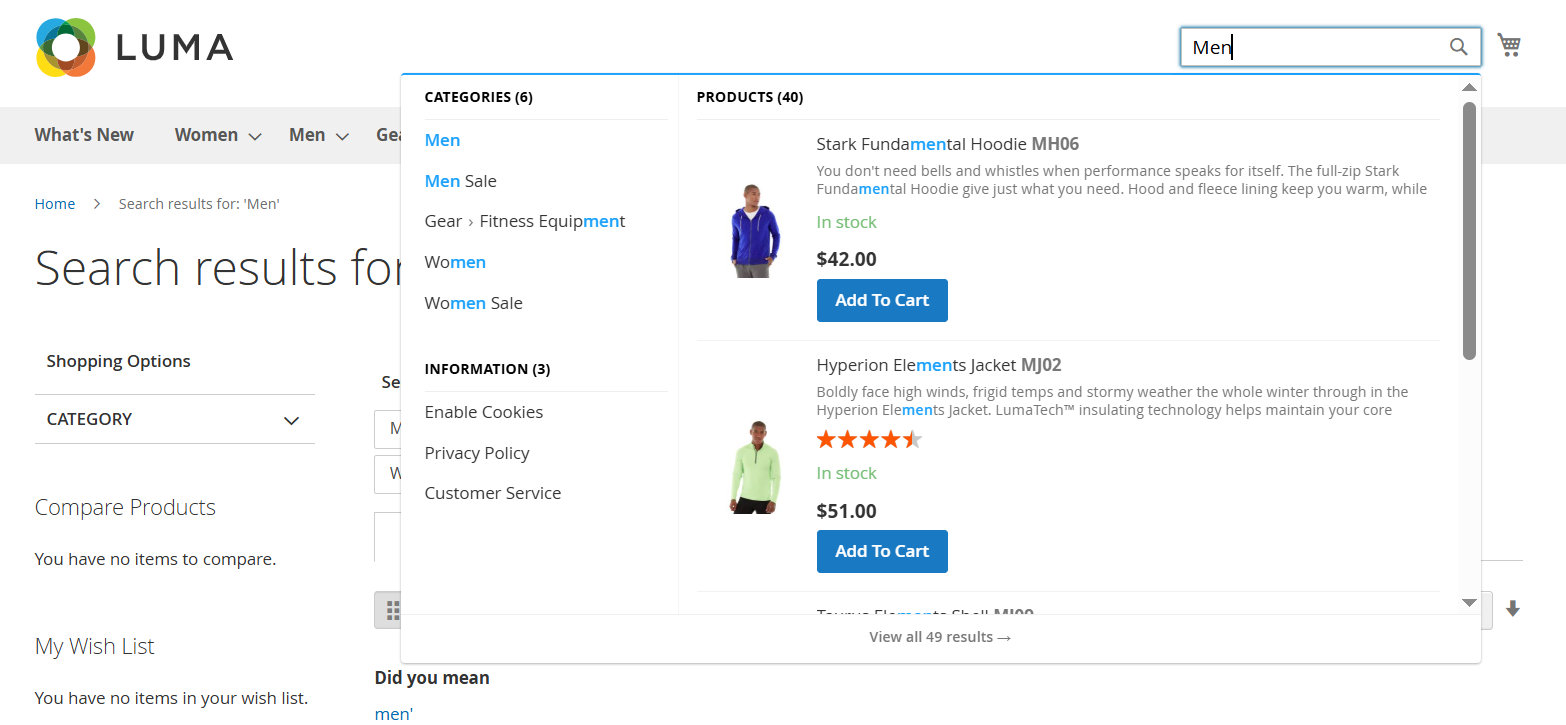
When users start typing in the search bar, the autocomplete panel appears below the search field and displays results in a single-column structured layout. This layout presents all result types (categories, products, CMS pages) in a unified vertical list, making it simple and compact for quick scanning.
- The autocomplete dropdown appears instantly as the user types a search term.
- All results are displayed in a single vertical column, instead of being split into sections.
- Different result types such as Categories, Products, and CMS pages appear in one continuous list.
- Matching keywords are highlighted within the results for better visibility.
- Product results include key details like image, name, price, stock status, and Add to Cart option.
- The layout is compact and space-efficient, ideal for simpler storefront designs.
- A scroll bar appears when there are more results than visible space.
- A “View all results” link is provided at the bottom to access the full search results page.
Autocomplete Products Search Display (2-Column Layout)
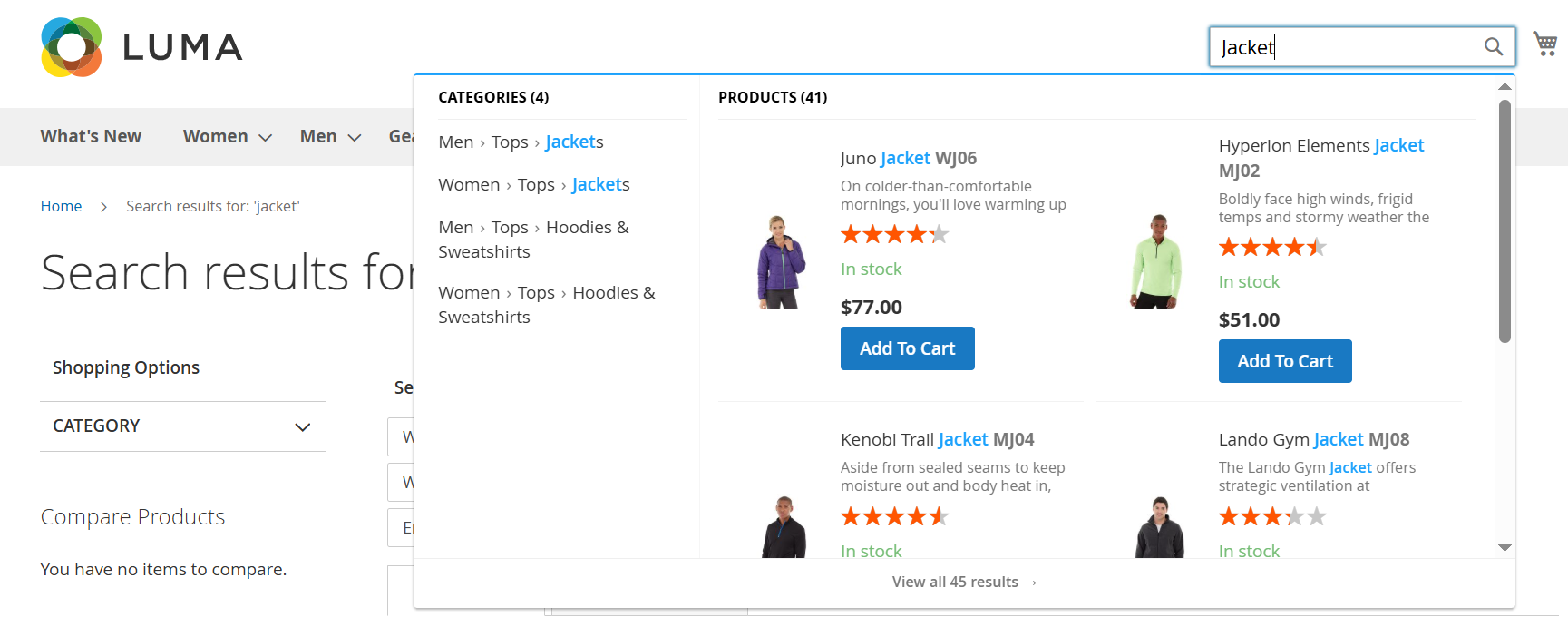
Full-Width Autocomplete Products Search Experience
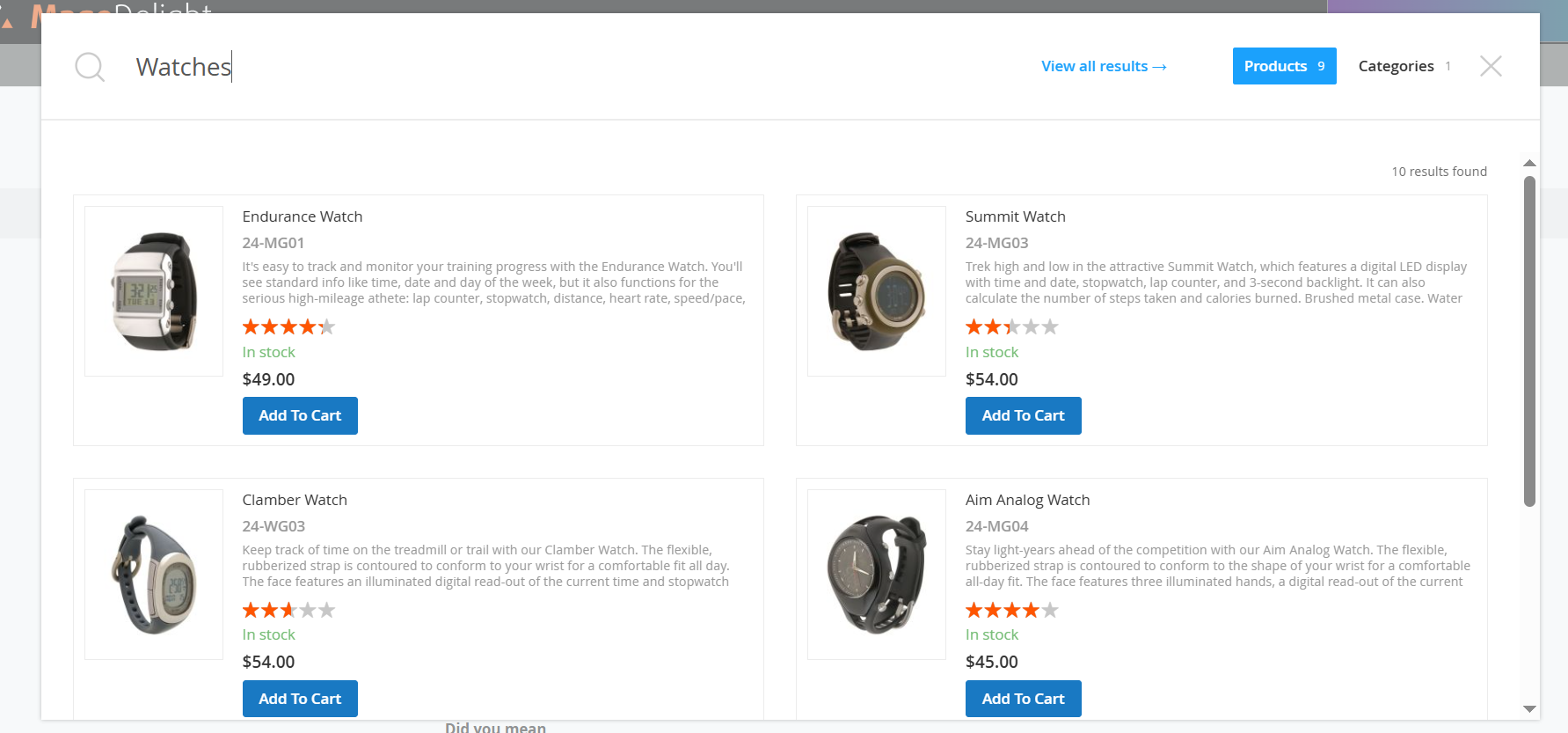
The full-width autocomplete layout provides an expanded, immersive search experience by displaying results in a large overlay panel. It allows users to browse multiple products with detailed information without leaving the current page.
- The autocomplete opens in a full-width overlay, covering the page for better focus and visibility.
- Displays products in a multi-column grid layout, showing more results at once.
- Each product includes image, name, SKU, short description, rating, price, and stock status.
- “Add to Cart” button is available directly within suggestions for quick purchase actions.
- Shows total result count and allows users to switch between Products and Categories tabs.
- Includes a “View all results” CTA to navigate to the full search results page.
- Supports scroll within the panel, enabling users to explore more results without page reload.
- Enhances user engagement by providing a rich, fast, and interactive search browsing experience.
Search Results with Highlighted Matches
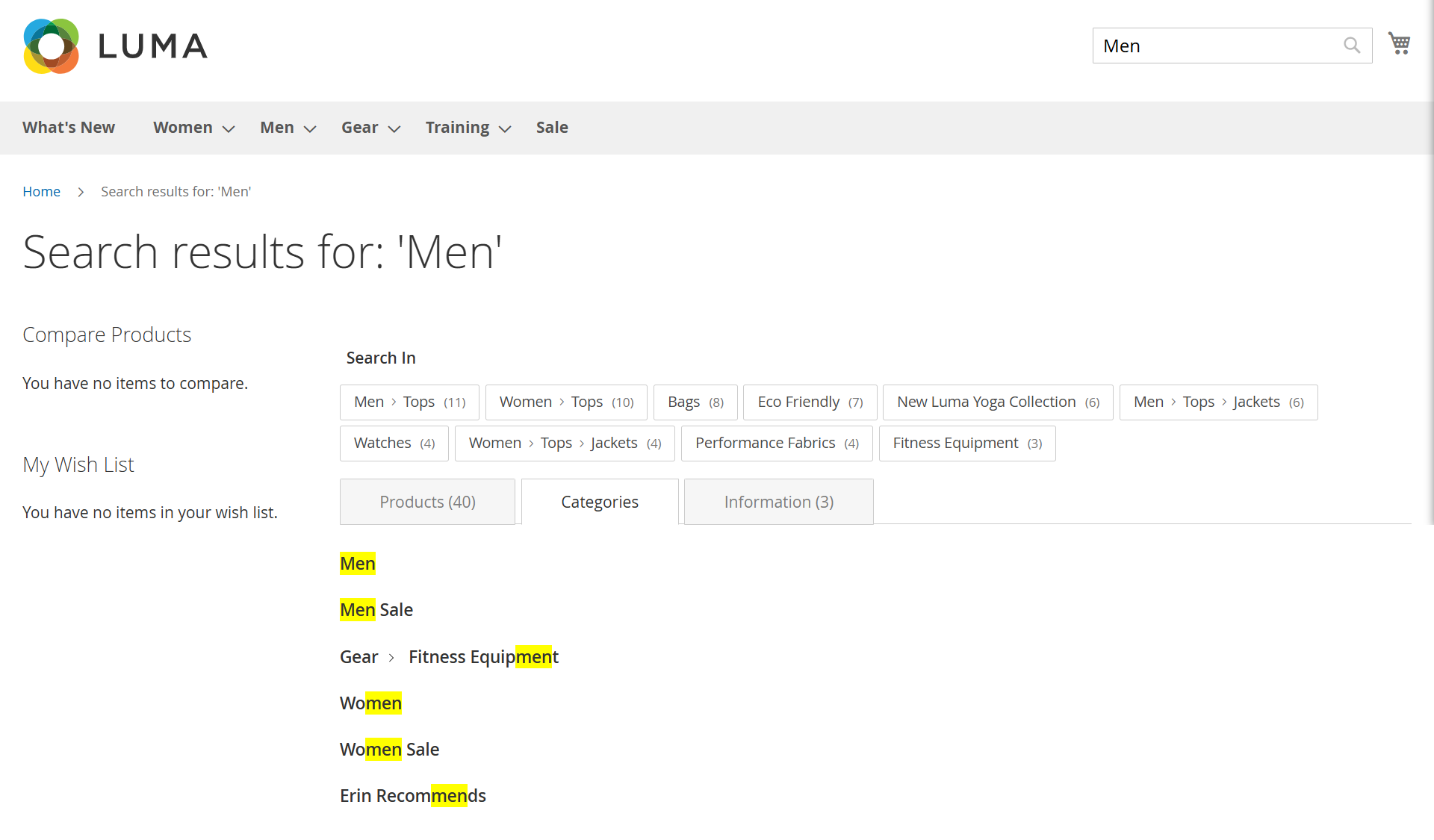
The search results page displays all relevant results based on the user’s query, with matched keywords clearly highlighted to improve visibility and user navigation. This helps users quickly identify how their search term relates to the results shown.
- The searched keyword (e.g., “Men”) is prominently displayed at the top of the results page.
- Matching terms are highlighted within categories, product names, and content, making them easy to scan.
- Results are grouped into sections such as Products, Categories, and Information for better organization.
- The “Search In” filters allow users to refine results by category or collection.
- Each section shows the count of matching results (e.g., Products (40), Categories, Information).
- Highlighting works across partial matches (e.g., Men in Women, Equipment, Recommends).
- Users can switch between tabs (Products, Categories, Information) to explore specific result types.
- The layout ensures users can quickly identify relevant results without reading full content.
Intelligent Search Suggestions (Did You Mean & Related Terms)
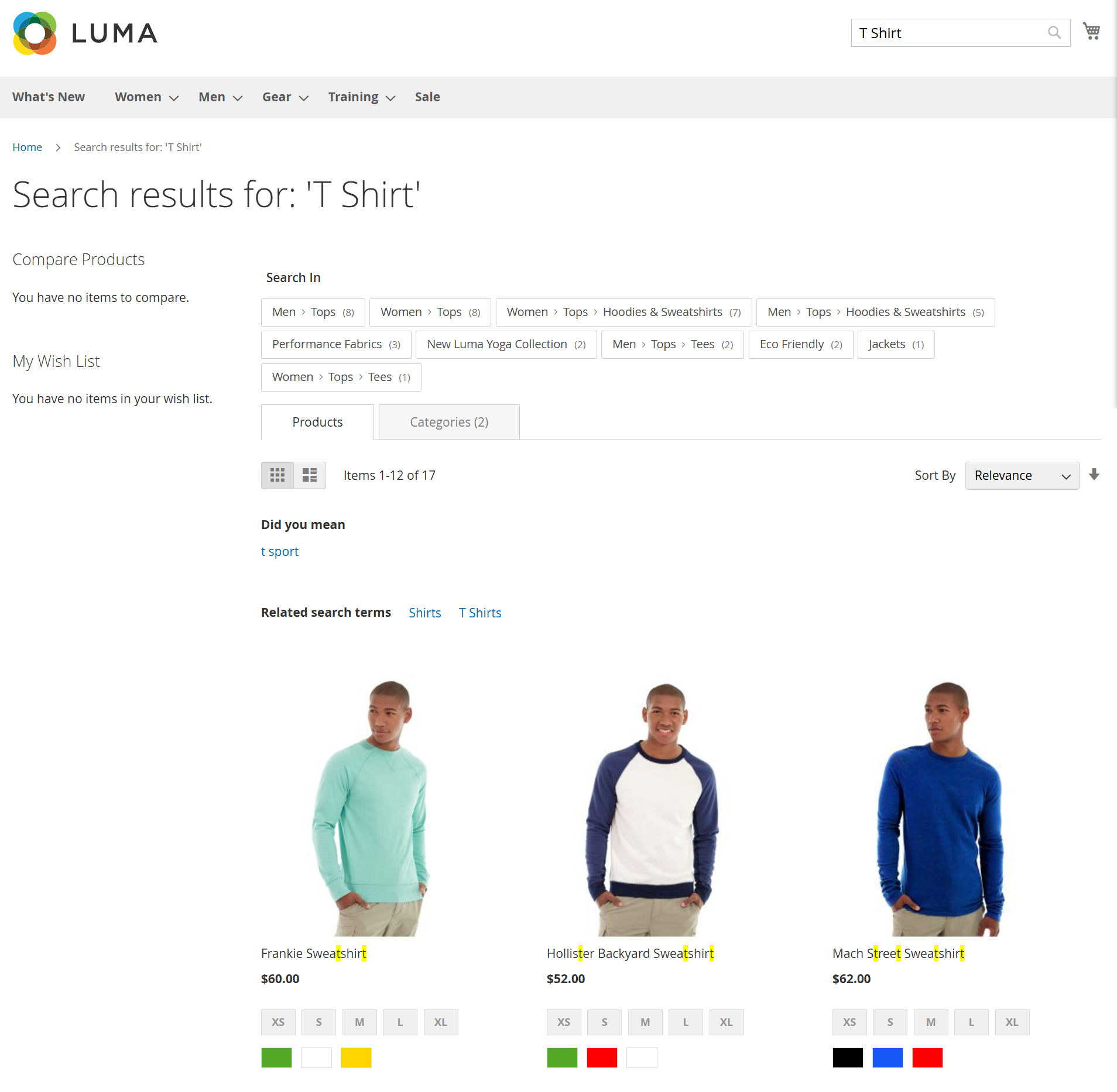
The search results page enhances user experience by automatically suggesting corrected queries and related search terms when a user enters a search phrase. This ensures users quickly find relevant products even if the original query is misspelled or not optimal.
- The searched keyword (e.g., “T Shirt”) is displayed clearly at the top, confirming the user’s query.
- A “Did you mean” suggestion appears when the system detects a better or corrected version of the query (e.g., t sport), helping recover from typos or mismatches.
- Related search terms (e.g., Shirts, T Shirts) are shown to guide users toward more relevant or popular variations.
- Suggestions are clickable, allowing users to instantly refine their search without retyping.
- Improves search accuracy and conversion by redirecting users to high-result queries.
- Works dynamically based on search behavior, synonyms, and indexed data.
Demo
Click here to visit frontend.
Click here to visit backend admin panel.
Thank you for choosing MageDelight!